The first thing you'll want to. We can confirm that our above equation in vertex form is the same as the original equation in standard form by.
Parabolas
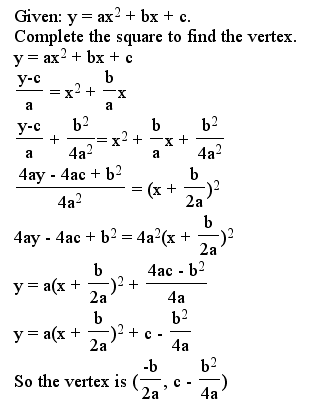
Vertex form to standard form converter check our vertex form calculator if you want to find the vertex of a quadratic function in a standard form.to find the vertex (h, k) of a parabola that is.

Find vertex of standard form. We'll start with the equation y = 7 x 2 + 42 x − 3 14. Axis of symmetry from standard form vertex form of equation the vertex form of a parabola's equation is generally expressed as: Contents [ hide] 1 quadratic equation of parabola:
If you don’t want to convert the standard form into the vertex form, find the vertex point using these formulas. The vertex form calculator is a online tool that helps to find the vertex point of a quadratic equation graph. The vertex formula is used to find the vertex of a parabola.
There are two ways to find the vertex of a parabola. From standard form, we can find the vertex and either factor or use the quadratic formula to find the intercepts. The intercept form of a quadratic equation is , where is the same value as.
F x ax 2 bx c. To convert from vertex form to standard form, we simply expand vertex form. The vertex form converter will.
1.1 from vertex to standard form conversion: So to convert the standard to vertex. Here (h, k) is the vertex.
To find the value of a, we can apply the. Simplify the binomial by multiplying by. To find equation of parabola from the given vertex and a point, we may use vertex form of the parabola.
Here, the vertex form has a square in it. When given the standard form of a quadratic ( ax2 + bx2 + c) you can find the h and k values as: To find the vertex of a parabola in vertex form, look at the constants h and k in the corresponding quadratic equation:
Let's walk through an example of converting an equation from standard form to vertex form. When given the vertex and a point without the graph the steps will work. Find vertex from the standard form:
You can find vertices using both standard or vertex forms.
Vertex to standard form calculator. Therefore, the vertex of the parabola is the point (1,4).

Chapter 5.7/Day 2 Quadratic Functions In Vertex Form - Ppt Download
The above formula can also be written as follows:
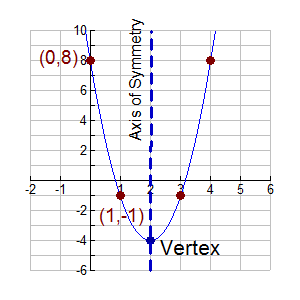
How to find axis of vertex form. Y = f (x) = x2 +6x +5 standard form ⇒ ax2 + bx + c = 0 consider the quadratic x2 + 6x +5 = 0 a = 1;b = 6 and c = 5 Then check your results analytically by writing the quadratic function in standard form. We'll start with the equation y = 7 x 2 + 42 x − 3 14.
V e r t e x = ( h, k) = ( − b 2 a, c − b 2 4 a) The standard form of a quadratic equation is ax 2 + bx + c. The first thing you'll want to do is move the constant, or the term without an x or x 2 next to it.
What are the focus and directrix of the parabola? As we know the standard equation of a parabola is y = ax 2 +bx+c. Just multiply out the squared part and simplify the entire expression.
Let’s find the equation for the axis of symmetry. The transformation can be a vertical/horizontal shift, a stretch/compression or a refection. The idea is to use the coordinates of its vertex ( maximum point, or minimum point) to write its equation in the form y = a ( x − h) 2 + k (assuming we can read the coordinates ( h, k) from the graph) and then to find the value of the coefficient a.
The vertex is the point (h,k). That is so true even ive been using this software since sometime now and it really helped me in solving on vertex form online calculator and vertex form online. Substitute the values in vertex formula:
One formula works when the parabola's equation is in vertex form and the other works when the parabola's equation is in standard form. Y a x h 2 k. There are two different formulas that you can use to find the axis of symmetry.
Important notes related to vertex of a parabola: The vertex form of a quadratic function is given by: Standard form if your equation is in the standard form y = a x 2 + b x + c , then the formula for the axis of symmetry is:
Use completing the square method to convert f (x) into vertex form. There are two ways to find the vertex of a parabola. In this case, our constant is − 3 14.
Let's walk through an example of converting an equation from standard form to vertex form. Converting from vertex form back to standard form is easy. The vertex formula of a parabola is used to find the coordinates of the point where the parabola crosses its axis of symmetry.
In our case, it is in vertex form. When given the standard form of a quadratic ( ax2 + bx2 + c) you can find the h and k values as: X = h is the axis of symmetry.
Your current quadratic equation will need to be rewritten into this form, and in order to do that, you’ll need to complete the square. Vertex form is another form of a quadratic equation. “h” and “k” are the coordinates of the vertex.
Get the equation in the form y = ax2 + bx + c. (we know it's negative 3 14 The equation of the described parabola is given by.
F (x) = a(x − h)2 +k, where (h,k) is the vertex of the parabola. The vertex formula is used to find the vertex of a parabola. Identifying the vertex allows us to calculate the location of the axis of symmetry.
X = − b 2 a First, we take note that in this equation, h = 1, and k = 4. [math processing error] ( − b 2 a, 4 a c − b 2 4 a) = ( − 6 2 ( 3), 4 ( 3) ( 0) − 6 2 4 ( 3)) therefore, the vertex of parabola is [math processing error] ( − 1, 3).
To do so, we use the following steps:
So y = − ( x + 1) ( x − 5) set x = 2 for the vertex (turning point) to find y = 9. Vertex of a top/bottom opened parabola
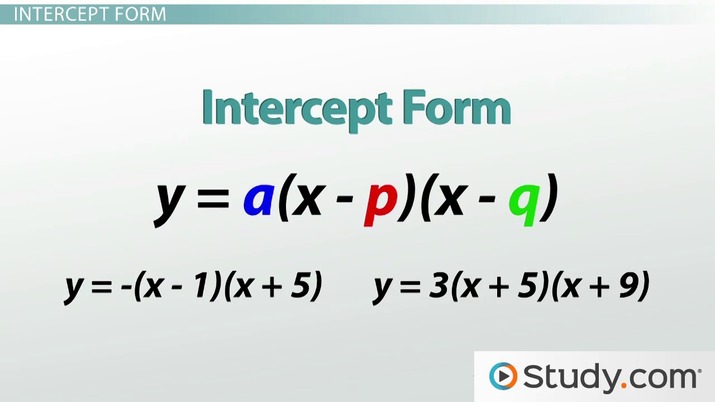
Parabolas In Standard, Intercept, And Vertex Form - Video & Lesson Transcript | Study.com
While the standard quadratic form is a x 2 + b x + c = y, the vertex form of a quadratic equation is y = a ( x − h) 2 + k.
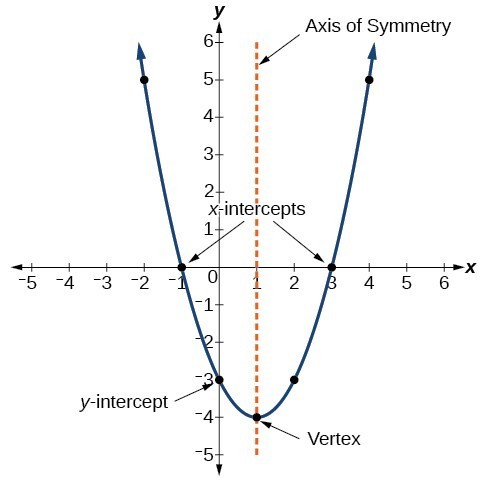
Parabola x intercept from the vertex form. Let us learn more about converting standard form to vertex form along with more examples. If x1 and x2 are the x intercepts of the graph then the x coordinate h of the vertex is given by (see formula above) This is something that we cannot immediately read from the standard form of a quadratic equation.
I really don't know how. Each of these pieces come together to help you make a sketch of its graph. The idea is to use the coordinates of its vertex ( maximum point, or minimum point) to write its equation in the form y = a ( x − h) 2 + k (assuming we can read the coordinates ( h, k) from the graph) and then to.
If a is negative, then the. Draw a parabola through the vertex. Vertex form makes it much easier to graph a parabola because it makes it easy to plot the vertex.
Finding the vertex x intercepts and axis of symmetry from graph a parabola you writing the equation of a quadratic given x intercepts and one other point you write the quadratic function given vertex and y intercept you quadratics parts of a. This is where opening downward commences. From standard form, we use a formula.
You have learned a lot about the basics of a parabola in vertex form. Use symmetry to plot two more points, such as (4, 3) and (5, 6). Find the coordinates of the vertex.
So to convert the standard to vertex form we need to complete the square. To graph the function, first plot the vertex (h, k) = (3, 2). Substitute x = 0 into the equation then simplify.
Here, the vertex form has a square in it. Can anyone help me to create a picture of the graph here. Now all that has to be done is to plug in points around the vertex, then graph.
Let us see the steps to find the vertex of the parabola in each case. To find the vertex of a parabola in vertex form, look at the constants h and k in the corresponding quadratic equation: There are two ways which we typically use to find the vertex of a parabola.
The formulas used are different depending on whether the equation is written in standard form or in vertex form. Standard form is y = ax2 + bx + c. Draw the axis of symmetry x = 3 plot two points on one side of it, such as (1, 3) and (1, 6).
A parabola can have either 2,1 or zero real x intercepts. Vertex form of equation the vertex form of a parabola's equation is generally expressed as: Plot the vertex at ( 5/2,1).
We can use the vertex form to find a parabola's equation. Each of the properties needs. Actually, this would be easy.
Y = a ( x + 1) ( x − 5) when x = 0 (this is the y intercept), a ( − 5) = 5, so a = − 1. This form is easiest to find the vertex from, since all we need to do is read the coordinates from the. From the roots ( x intercepts), you can write the equation of the parabola as:
It might look scary, but it’s not too bad, you’ll see. The x intercepts are the solutions to the equation f (x) = 0; Equation of the parabola is in vertex form :
From this equation, we can already tell that the vertex of the parabola is at (1,4), and the axis of symmetry is at x = 1.