Metals become oxidized when they lose electrons in their outer shells. There is no space between the element name and the parenthesis.
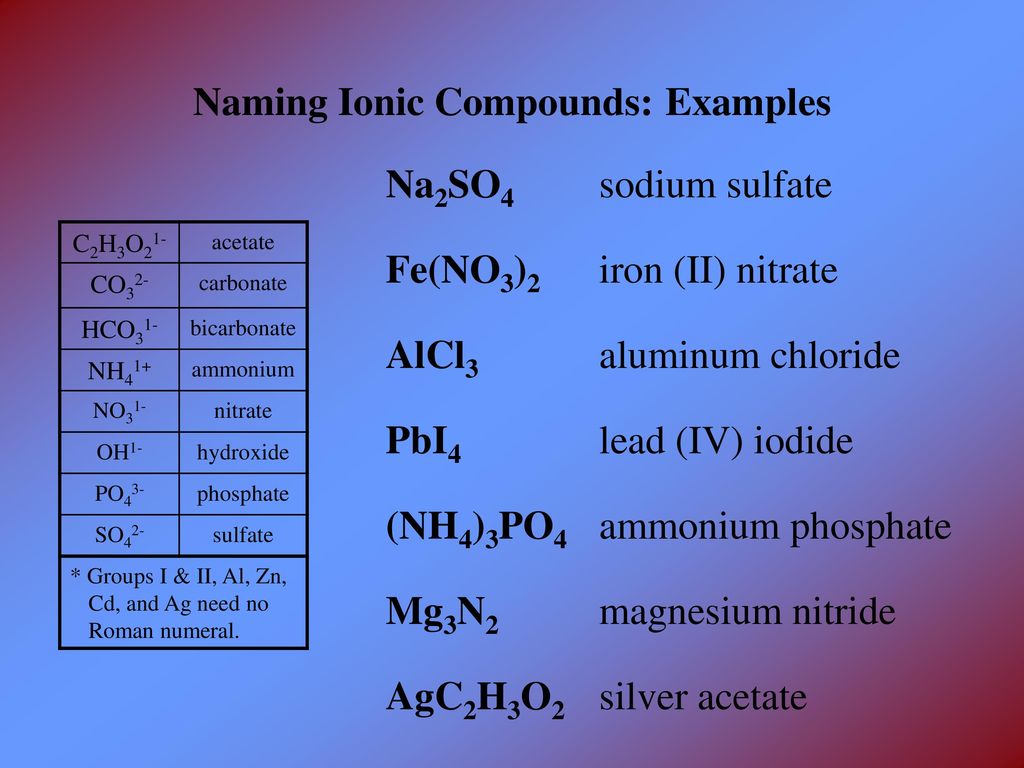
Naming Chemical Compounds: A Review - Ppt Download
An example is having both iron (ii)sulfate (feso4)and iron (iii) sulfate ( (fe2 (so4)3)) as potential compounds.

When do you put roman numerals in naming compounds. It's used for transition metals in ionic compounds. However, in other compounds it might give two or three electrons and gain +2 (ii) or +3 (iii) charges, respectively. And the roman numerals indicate the charges that these metals carry in a compound.
This variation in charges is the reason that roman numerals are used chemistry. In chemistry nomenclature (writing names systematically), roman numerals are used for a specific group of elements. The roman numerals after an ion indicate the charges and therefore help name the compound.
Name of metal (oxidation number in parentheses) name of anion. In naming the transition metal ion, add a roman numeral in parenthesis after the name of the transition metal ion. The metals that form to a greater extent than one ion are the transition metals, although non all of them do this.
Do you need roman numerals when naming covalent compounds? Apr 24, 2015 you name ionic compounds with roman numerals according to the format: Roman numerals in ionic compound names a roman numeral in parentheses, followed by the name of the element, is used for elements that can form more than one positive ion.
This notation is usually seen with metals since they commonly display more than one oxidation state or valence. There are six different covalent compounds that can form between nitrogen and oxygen and in two of them, nitrogen has the same oxidation number. When naming coordination compounds, the roman numeral is the oxidation number of the transition metal.
The number of atoms in the formulas must be indicated with covalent compounds, however, we have a very different situation. Fecl = iron (i) chloride and fecl2 = iron. When you’re naming any ionic compound, you rules are basically.
These elements are called transition metals. These types of metals can have multiple oxidation states. I'll try to answer this.
Do you use roman numerals covalent compounds? This is also called the oxidation states of these metals. When we name their compounds, we have to specify which oxidation number is involved.
For ionic compounds with transition metals, you need to insert a roman numeral after the name of the metal to indicate the transition metal’s charge ex: What does the roman numeral in a chemical name indicate? The roman numeral must have the same value as the charge of the ion.
If your problem has a roman numeral in it, it means you’re naming a transition metal compound! So, if you were dealing with fe 2+, the oxidation number would be (ii), and if it were fe 3+ it would be (iii), and so on. Why do you use roman numerals when naming compounds?
All metals except al, zn, and those in groups 1 and 2 can have more than one oxidation number. Thus, sulfur tetrafluoride, sf4, would have been called s (iv) fluoride and sulfur hexafluoride, sf6, would have been called s (vi) fluoride.
The use of roman numerals in chemical nomenclature is to indicate the charge of the ion. This is also called the oxidation states of these metals.
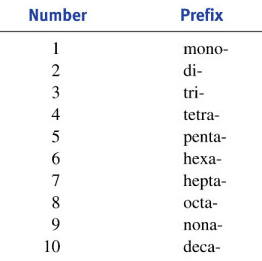
4 Steps To Naming Compounds In Chemistry Nomenclature | By Ernest Wolfe | Countdown.education | Medium
The roman numeral must have the same value as the charge of the ion.

When do you use roman numerals in naming compounds. Combining with chlorine, it will form cucl and cucl 2 respectively. This variation in charges is the reason that roman numerals are used chemistry. Some metals have the ability to form differently charged ions.
For ionic compounds with transition metals, you need to insert a roman numeral after the name of the metal to indicate the transition metal’s charge ex: The metals that form to a greater extent than one ion are the transition metals, although non all of them do this. For example, fe (ii) stands for fe2+ and fe (iii) stands for fe3+;
So, the first compound, formed from copper 1+ ions will be called copper (i) chloride. The names consist of two words: Fecl = iron (i) chloride and fecl2 = iron.
The roman numerals after an ion indicate the charges and therefore help name the compound. And the roman numerals indicate the charges that these metals carry in a compound. Name of metal (oxidation number in parentheses) name of anion.
Keeping this in consideration, how do you use roman numerals when naming compounds? Do you need roman numerals when naming covalent compounds? However, in other compounds it might give two or three electrons and gain +2 (ii) or +3 (iii) charges, respectively.
The number of atoms in the formulas must be indicated with covalent compounds, however, we have a very different situation. These elements are called transition metals. Click to see full answer.
In naming the transition metal ion, add a roman numeral in parenthesis after the name of the transition metal ion. For example, iron can form ##2+## or ##3+## ions. In chemistry nomenclature (writing names systematically), roman numerals are used for a specific group of elements.
The roman numerals are used to show the oxidation number of transition metals because some elements have more than one possible oxidation state. In our example, the transition metal ion fe2+ would have the name iron(ii). Usually, the transitional metal has multiple possible ion charges.
There are six different covalent compounds that can form between nitrogen and oxygen and in two of them, nitrogen has the same oxidation number. An overview of naming molecular and ionic compounds common to general chemistry. Why do you use roman numerals when naming compounds?
You name ionic compounds with roman numerals according to the format: Focuses on when to use greek prefixes and roman numerals, and how to quickly identify the presence of a polyatomic. All metals except al, zn, and those in groups 1 and 2 can have more than one oxidation number.
A as a rule, we use roman numerals in the name of a compound when a metal cation forms two ions with different states of oxidation. Thus, sulfur tetrafluoride, sf4, would have been called s (iv) fluoride and sulfur hexafluoride, sf6, would have been called s (vi) fluoride. When we name their compounds, we have to specify which oxidation number is involved.
The charge changes according to the number of electrons on the atom.