Ρh2 = p rt × 2.016 ⋅ g ⋅ mol−1. Also included are two practice problems using d=mp/nrt and d=mp/rt including molar mass a.
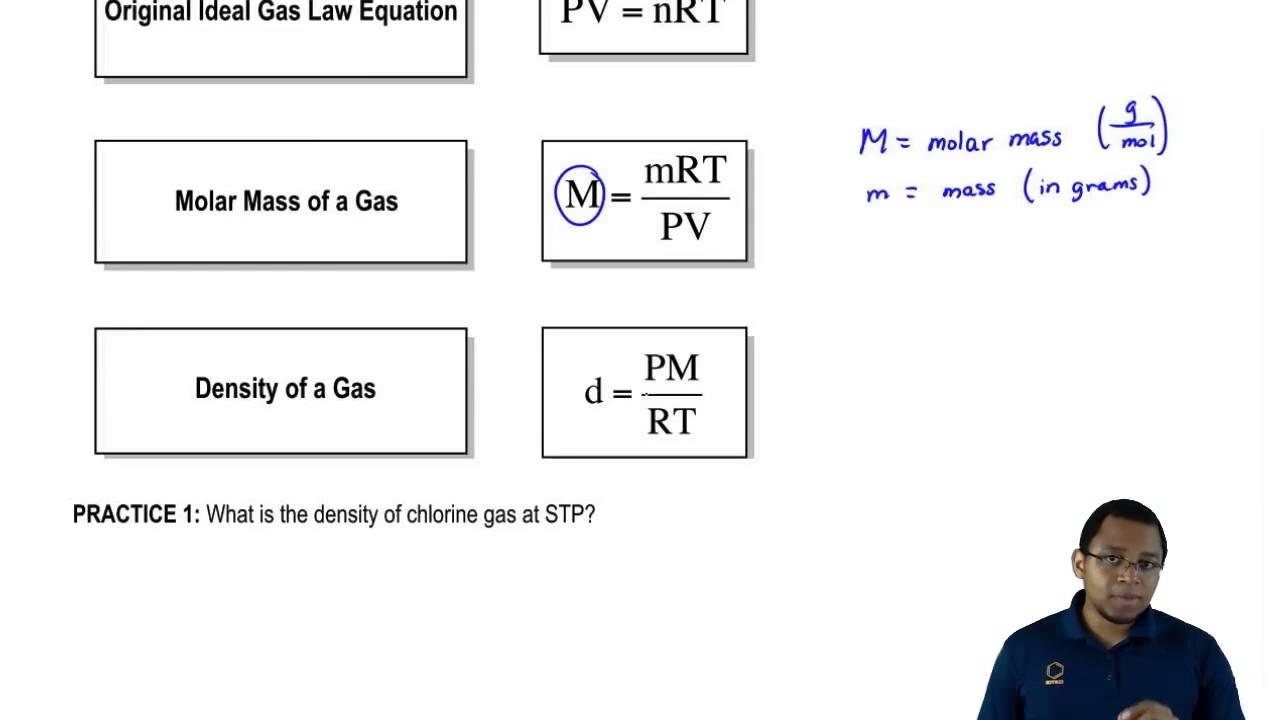
Using The Ideal Gas Law To Find Density Or Molar Mass - Youtube
Math geometry physics force fluid mechanics finance loan calculator.

Density in gas law. Combined with avogadro's law (i.e. This means that at an unchanged temperature and pressure conditions, the molar mass of every gas is directly proportional to its density. The temperature in tank is 70 of.
Graham's law states that the rate at which gas molecules diffuse is inversely proportional to the square root of the gas density at constant temperature. The density d of a gas, on the other hand, is determined by its identity. The density of gases can be computed using the ideal gas law.
Density = total mass total volume = n 1 m 1 + n 2 m 2 ( n 1 + n 2) r t / p = p ( n 1 m 1 + n 2 m 2) ( n 1 + n 2) r t = p m avg r t. Gas density is defined as the mass of the gas occupying a certain volume at specified pressure and temperature. The ideal gas law, also called the general gas equation, is the equation of state of a hypothetical ideal gas.it is a good approximation of the behavior of many gases under many conditions, although it has several limitations.
The ideal gas law is applicable for gases that have the following characteristics: The chemical formula as well as molar mass has also been listed. I do not understand what you're denoting by m r.
O r]* (70+ 460) [°r]) = 0.0102 [slugs/ft3] the weight of the air is the product of specific weight and the air volume. Since equal volumes have equal number of molecules) this is the same as being inversely proportional to the root of the molecular weight. Substitute the correct values into this equation and you're good to go.
Density is defined as mass per unit volume. The collisions between the gas particles are. Multiplication of the left and right sides of equation 5.5.1 by the molar mass in g/mol ( m) of the gas gives (5.5.2) ρ = g l = p m r t this allows us to determine the density of.
Density of a gas is generally expressed in g/l (mass over volume). In addition, the density of a gas is equal to its mass divided by its volume. We note that hydrogen gas, as are all elemental gases.
And recall that volume percent is equivalent to mole percent, as you correctly did already. Ρ = pm/rt, where m is molar mass. How to find density of a gas calculating the density of a gas usually involves combining the formula for density (mass divided by volume) and the ideal gas law (pv = nrt).
The air density can be calculated with a transformation of the ideal gas law (5) to: With this information we can calculate the density () of a gas using only its molar mass. The above gas laws provide us with an indication of the various properties of gases at changed conditions of temperature, pressure volume and mass.
The ideal gas law is pv = nrt, so if you know enough values, you can calculate volume (v) or the number of moles (n). The density is usually represented in units of lbm/ft3. Moreover, you can calculate the molar mass of a substance once you know the density of a gas.
Below the table is an image version for offline viewing Density, mass of a unit volume of a material substance. Density is the ratio of mass over volume.
What is gas density and how does it fit mathematically into pv=nrt? The ideal gas law is universal, relating the pressure, volume, number of moles, and temperature of a gas regardless of the chemical identity of the gas: Sometimes you then have to convert number of moles to grams.
Ideal gas law equations calculator science physics chemistry formulas. In other words, 1 mole of a gas will occupy 22.4 l at stp, assuming ideal gas behavior. = 1 ⋅ atm ×2.016 ⋅ g ⋅ mol−1 0.0821 ⋅ l⋅atm k⋅mol × 298 ⋅ k ≅0.1 ⋅ g ⋅ l−1.
Ρ = p / (r t) (7) ρ = ( (50 [lb/in 2 ]+ 14.7 [lb/in 2 ])*144 [in 2 /ft 2 ]) / (1716 [ft.lb/slug. Noting that m/v is density, ρ, the equation can be written as p (mw) = (m/v)rt = ρrt. Solving for ideal gas density.
And thus our working equation. The ideal gas law is a. Gas density is a function of the pressure and temperature conditions for the gas.
Another common density representation is the “gas gradient” that is expressed in units of psi/ft. What is the formula for calculating density? At stp, the volume of a gas is only dependent on number of moles of that gas and is independent of molar mass.
First, starting with the definition of density Ideal gas law equation calculator solving for density given pressure, specific gas constant and temperature. Density of gas we can define it as the mass per unit volume of a substance under specific conditions of temperature and pressure.
Mass v density=ρ = p rt ×molar mass. We can introduce the density of the gas into the equation by making use of the fact that molecular weight (mw) has units of mass/mole, and thus that n = m/mw, and that the ideal gas law can be written as:
= 1 ⋅ atm ×2.016 ⋅ g ⋅ mol−1 0.0821 ⋅ l⋅atm k⋅mol × 298 ⋅ k ≅0.1 ⋅ g ⋅. The gas consists of a large number of molecules that move around randomly.
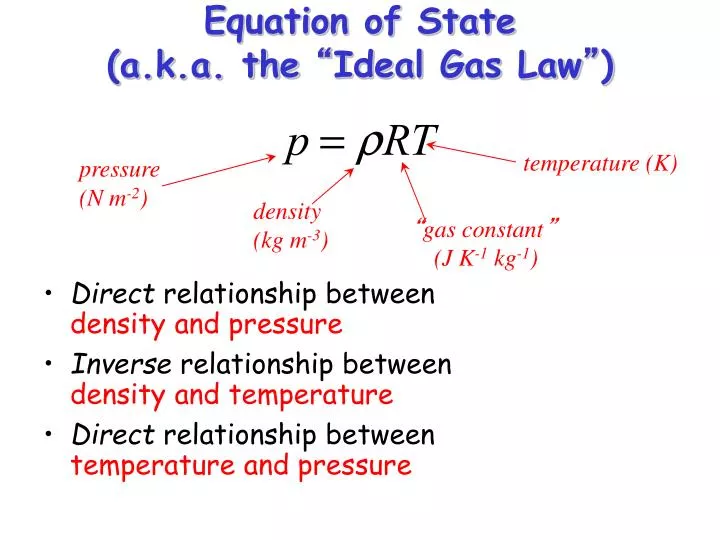
Ppt - Equation Of State (A.k.a. The “ Ideal Gas Law ” ) Powerpoint Presentation - Id:2230613
What is the density standard for gases?
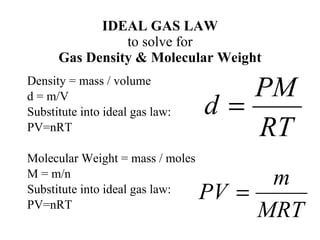
Density & the ideal gas law. The ideal gas law is universal, relating the pressure, volume, number of moles, and temperature of a gas regardless of the chemical identity of the gas: Gas density pv = nrt is an equation, and it can be manipulated just like all other equations. The density d of a gas, on the other.
If you happen to know how much gas you have and its volume, the calculation is easy. An ideal gas is a special case of any gas that fulfills the following conditions: Using the ideal gas law to calculate gas densities and molar masses the ideal gas law can also be used to calculate molar masses of gases from experimentally measured gas densities.
For a given p and t you. Using the ideal gas law to determine the density of a gas. And thus our working equation.
The state of an amount of gas is determined by its pressure, volume, and temperature. Ideal gas law equation calculator solving for density given pressure, specific gas constant and temperature. The official iupac unit for gas density is kg/m 3 (not g/l).
What is the density standard for gases? The pressure, , volume , and temperature of an ideal gas are related by a simple formula called the ideal gas law. Math geometry physics force fluid mechanics finance loan calculator.
Using the ideal gas law to calculate gas densities and molar masses the ideal gas law can also be used to calculate molar masses of gases from experimentally measured gas densities. Density is defined as mass per unit volume. The ideal gas law the relationship between volume, pressure, temperature and quantity of a gas, including definition of gas density.
Usually, you only have implied information. However, it turns out that one kg/m 3 equals one g/l. Deviations from ideal behavior • no gas is truly ideal;
However, it turns out that one kg/m 3 equals one g/l. The ideal gas law, molar mass, and density there are several relationships between the temperature, pressure, the number of moles and the volume of gases. Here is a brief video explaining the.
The official iupac unit for gas density is kg/m 3 (not g/l). The ideal gas law says you something about p, v and t in terms of the number of particles. Mass v density=ρ = p rt ×molar mass.
The ideal gas law and molar mass and density of a gas. The simplicity of this relationship is a big reason why we typically treat. We can introduce the density of the gas into the equation by making use of the fact that molecular weight (mw) has units of mass/mole, and thus that n = m/mw, and that the.
The appropriate si unit is the kelvin. Density of gas by ideal gas law solution step 0: Ρh2 = p rt × 2.016 ⋅ g ⋅ mol−1.
He is the closest • all gas particles have volume • all gas particles interact • no collision is purely elastic • ideal behavior. The modern form of the equation relates these simply in two main forms. That's nice, because it holds approximately for all gases.
The most frequently introduced forms are: With this in mind, let's see how the ideal gas law can help us calculate gas density. In a perfect or ideal gas the correlations between.
The temperature used in the equation of state is an absolute temperature: Here is a brief video.
What is the density of the ideal gas? Chemistry lecture that introduced density into the ideal gas law.
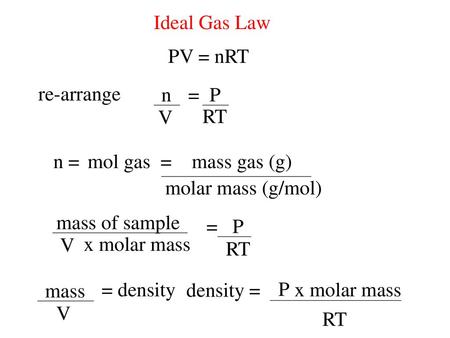
Ideal Gas Law Pv = Nrt Re-Arrange N V = P Rt N = Molar Mass (G/Mol) Mol Gas= Mass Gas (G) Mass Of Sample V X Molar Mass = P Rt =
Here is the ideal gas law equation rearranged to solve for v:

Density and the ideal gas law. Ideal gas molecules do not attract or repel each other. Ideal gas law equation calculator solving for density given pressure, specific gas constant and temperature. However, it turns out that one kg/m 3 equals one g/l.
The ideal gas law is universal, relating the pressure, volume, number of moles, and temperature of a gas regardless of the chemical identity of the gas: Density and specific volume density. The ideal gas law, also called the general gas equation, is the equation of state of a hypothetical ideal gas.it is a good approximation of the behavior of many gases under many conditions,.
Absolute pressure (p), volume (v), and absolute temperature (t). Gas density pv = nrt is an equation, and it can be manipulated just like all other equations. Other variations of the ideal gas law are discussed below.
Here is a brief video. Deviations from ideal behavior • no gas is truly ideal; An ideal gas can be characterized by three state variables:
He is the closest • all gas particles have volume • all gas particles interact • no collision is purely elastic • ideal behavior. Density of a gas is generally expressed in g/l (mass over volume). The density d of a gas, on the other.
The only interaction between ideal gas. Math geometry physics force fluid mechanics finance loan calculator. Calculation of density of an ideal gas.
The density is defined as the ratio of the mass to the volume. The term ideal gas refers to a hypothetical gas composed of molecules which follow a few rules: The ideal gas law can be expressed with the individual gas constant.
Ideal gases versus real gases. What is the density standard for gases? The original ideal gas law uses the formula pv = nrt, the density version of the ideal gas law is pm = drt, where p is pressure measured in atmospheres (atm), t is.
Multiplication of the left and right sides of equation 5.5.1 by the molar mass in g/mol ( m) of the gas gives. The official iupac unit for gas density is kg/m 3 (not g/l). To find the density of the gas, you need to know the mass of the gas and the volume.
The ideal gas law, molar mass, and density there are several relationships between the temperature, pressure, the number of moles and the volume of gases. P v = m r t (4) where p = absolute pressure [n/m 2 ], [lb/ft 2] v = volume [m 3 ], [ft 3] m = mass [kg], [ slugs] r =. By doing some algebra, the ideal gas equation can be rearranged to include density.
The relationship between them may be deduced from kinetic. We can introduce the density of the gas into the equation by making use of the fact that molecular weight (mw) has units of mass/mole, and thus that n = m/mw, and that the. Molar volume molar volume vm is defined as the volume of gas per unit mole.
The density of an ideal gas depends on the. With this in mind, let's see how the ideal gas law can help us calculate gas density. Density of gas by ideal gas law solution step 0:
The ideal gas law applies to ideal gases.an ideal gas contains molecules of a negligible size that have an average molar kinetic energy.