As can be seen from the figure, alpha particle is emitted in alpha decay. An excited state) it will decay to a more stable state (i.e.

Beta Decay - Wikipedia
Processes like beta decay and alpha decay allow the nucleus of the radioactive sample to get as close as possible to the optimum neutron/ proton ratio.

Alpha decay vs beta decay. The nucleus has its atomic number reduced by 2 and its mass number is reduced by 4 (2 protons and 2 neutrons are removed). Alpha decay forms new element with two fewer protons and two fewer neutrons; In both alpha and gamma decay, the resulting alpha or gamma particle has a narrow energy distribution, since the particle carries the energy from the.
In both cases the charge of the nucleus changes, and hence it becomes an atom of a different element. Gamma decay forms no new element, but now the element has less energy because energy is released as gamma rays. Alpha vs beta decay cover the initial nuclear decay modes, and after the initial decay if the nucleus is in an unstable state (i.e.
In this case, the mass number of daughter nucleus remains the same, but daughter nucleus will form different element. This transition can be characterized as: Beta decay is a type of radioactive decay in which a proton is transformed into a neutron or vice versa inside the nucleus of the radioactive sample.
Alpha particles are energetic nuclei of helium. This nuclear chemistry video tutorial provides a basic introduction into radioactive decay such as alpha decay, beta decay, gamma decay, electron capture and positron production. Alpha decay releases a helium nucleus, while beta decay only releases an electron.
Alpha decay is when it emits a helium nucleus, that is two protons and two neutrons bound in the same particle. The emitted alpha particle is also known as a helium nucleus. This decreases the total mass by 4 and the atomic number by 2.
The spectrum of kinetic energies of the alpha particles immediately after decay will be as shown in fig. Difference between alpha, beta and gamma radioactive decay can be summarized as follows: An alpha particle is a combination of two protons and two neutrons, which if you know your periodic table you’ll recognize as a helium nucleus.
Alpha decay is the release of a helium nucleus, which is two protons and two neutrons. Thus the fixed total kinetic energy will always be split between the alpha and the daughter nuclues in the same way, depending on the mass of each. Beta decay is the decay of a neutron into a proton, which releases an electron.
Learning about these forms of nuclear decay is a crucial part of any nuclear physics course. While doing so, the nucleus emits a beta. This transition can be characterized as:
David kahana physicist unhinged upvoted by dimosthenis e. Beta decay forms new element with one more proton and one fewer neutron. This transition can be characterized as:
Beta decay in beta decay (minus) a neutron turns into a proton. Alpha particles are energetic nuclei of helium. As can be seen from the figure, the alpha particle is emitted in alpha decay.
As can be seen from the figure, the alpha particle is emitted in alpha decay. Here the atomic mass number of the newly formed atom will be reduced by four and the atomic number will be reduced by two. Beta decay or β decay represents the disintegration of a parent nucleus to a daughter through the emission of the beta particle.
Beta decay is when the nucleus emits an electron. Alpha decay the nuclear disintegration process that emits alpha particles is called alpha decay. The study of beta decay provided the first physical evidence for the existence of the neutrino.
(the atomic mass of 222 rn 222 rn is 222.01757 u and that of. The equation for the alpha decay of 239pu is:
Radioactive Decay Honors
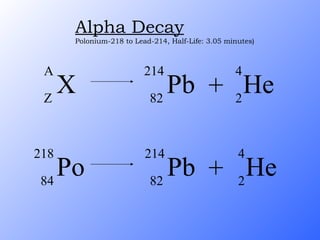
The isotope 218/84po can decay by either or emission.

The alpha decay of 218 84po. The alpha particle, structurally equivalent to the nucleus of a helium atom and. Let's write out the reaction. Um, from both well, from first the alfa decay process and next, the beta negative decay process for an alfa decay.
In alpha decay, an unstable nucleus will emit an alpha particle, which is a helium nucleus composed of two protons and neutrons. The parent adam here is ah,. The mass of 218/84po, 214/82pb, 4/2he and 218/85at is 218.008973 u, 213.999798 u,.
What is the energy released in this alpha decay reaction 222 86rn→218 84po+4 2he 86 222rn→84 218po+2 4he? What is the nuclear decay equation for an example of alpha decay? This decreases the total mass number by 4 and the atomic number by 2.
Answer 8.6 × 10 − 7 upgrade to view answer discussion. Problem 56 medium difficulty (ii) use fig. Alpha decay is the loss of two protons and two neutrons from a nucleus.
What is the alpha decay of 218 84 po? In an experiment starting with 1gm atom of pure po 218 ,how much time would be. What is the energy release in each case?
Alpha decay is the nuclear decay process whereby the parent nucleus emits an alpha particle. Using the table of masses the po 218 has a mass of 218.008973 and the pb.