Elements in the same group form ions with the same charge. Copper (i) ions have a 1+ charge.

G-Factor Dependence On The Effective Nuclear Charge Of Copper Ion Z Eff... | Download Scientific Diagram
Sarcophagine (sar) chelators form extremely stable complexes with copper and are therefore a promising option for labeling proteins with 64cu.

Ionic charge of copper. Cu is the neutral atom of copper; Its formula is cu + copper (ii) ions have a 2+ charge. Copper has two ionic charges:
This happpens when copper atoms lose two electrons. For example, iron(ii) has a 2+ charge; As for why, it comes down to quirks in ion stability.
Copper (cu) is a transition metal and therefore it can have a different ionic charge depending what it is chemically bonded to. Although noble gas atoms almost always carry a charge of zero, these elements do form compounds, which means they can gain or lose electrons and carry a charge. What is the ionic charge for the copper ion in cus?
What is the ionic charge of solid copper metal? This happens when copper atoms lose two electrons, its formula is cu 2+. Roman numeral notation indicates charge of ion when element commonly forms more than one ion.
This happens when copper atoms lose one electron. The cu+ and cu 2+ ions, name. However, other charges are possible.
Ionic charges chart (cations and anions) cations 1+. Sarcophagine (sar) chelators form extremely stable complexes with copper and are therefore a promising option for labeling proteins with 64 cu. Copper(i) cu+ 2+ barium ba2+ beryllium be2+ cadmium.
The number in the name of the. Recent presentations content topics updated contents featured contents. Roman numeral notation indicates charge of ion when element commonly forms more than one ion.
First ionization energy of copper is 7.7264 ev. Transition metals (in the central block between groups 2 and 3) can have ions with different charges. Medium solution verified by toppr copper (i) and copper (ii) explanation:
Ionization energy, also called ionization potential, is the energy necessary to remove an electron from the neutral atom. What is the ionic charge of copper? This happens when copper atoms lose one electron.
The 29 electrons fill up the 1s, 2s, 2p, 3s, 3p, and 4s orbitals using 20 electrons, and leaving only 9 for the inner 3d orbital, which needs 10 to be stable. The development of biomolecules as imaging probes requires radiolabeling methods that do not significantly influence their biodistribution. Check out a sample q&a here see solution star_border
The development of biomolecules as imaging probes requires radiolabeling methods that do not significantly influence their biodistribution. X + energy → x+ + e− Copper (ii) ions have a 2+ charge.
Cu 2+ is the cation of cu, which has lost 2 electrons what is the difference between cu 2+ and cu + ? Elemental copper has an atomic number of 29, meaning it has 29 protons and 29 electrons to start. (don't google, this may not be a real compound) o 2+ o 1+ o zero 3+ none of the above expert solution want to see the full answer?
When the atom loses or gains one or more electrons,. 1+, copper i, aka cuprous and 2+, copper ii, aka cupric. Copper sulfate is an ionic compound whose overall charge is zero.
Copper (i) ions have a +1 charge. Ionic charges 1 / 13. 93 rows ionic charge:
What is the ionic charge for the copper ion in cus? 93 rows the most common charges are based on maximum stability for the atom. The copper ions have a +2 charge.
What is the formula for the equation zinc. This will give a blue solution with a reddish.
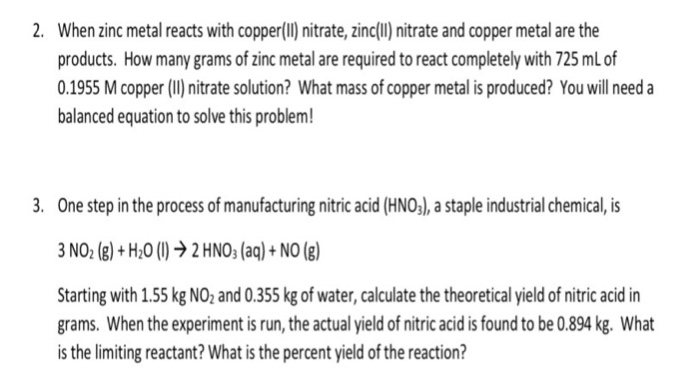
Solved 2. When Zinc Metal Reacts With Copper(Ii) Nitrate, | Chegg.com
In this reaction, copper is oxidized to its.
Copper reacts with zinc nitrate. Zn (s) zinc + agno 3 (aq) silver nitrate → zn (no 3) 2 (aq). The video's actual length is approximately 20 minutes and is condensed into about a. They could, since zinc is more reactive than copper, and could displace it to form zinc nitrate.
The zinc is more reactive metal than copper, therefore zinc displaces copper. Do zinc and copper nitrate react? Zinc is more reactive than copper and so it will displace the copper from the copper nitrate and become zinc nitrate and leave copper on it’s own.
What happens when zinc reacts with zinc nitrate? Z n ( s) + c u ( n o 3) 2 ( a q) → z n ( n o 3) 2 ( a q) + c u ( s) in this reaction, zinc reacts with copper. Copper is an unreactive metal and doesn’t react in normal circumstances with dilute acids.
However, it does react with nitric acid. Electrolysis of a zinc nitrate solution produces oxygen at the anode and zinc at the cathode. A dark coating of copper metal appears on the zinc within two minutes and when 45 minutes have elapsed, there is a thick coat of copper metal powder on the zinc strip and the blue color of the.
The chemical equation for the reaction of zinc with copper (ii) nitrate is shown below. Copper is more reactive than silver. A time lape video of the reaction between silver nitrate and copper wire.
When you add a strip of zinc metal to. Concentrated nitric acid reacts with copper and produce copper nitrate ( cu (no 3) 2 ), nitrogen dioxide (no 2) gas and water as products. Zn + 2 hno 3 (diluted) → zn(no 3) 2 + h.
In the given reaction, zinc reacts with silver nitrate to form zinc nitrate and silver. The chemical reaction can be represented as: What does zinc and copper nitrate make?
Nitric acid is an oxidizing agent and. When copper reacts with agno 3 (silver nitrate), cu (copper) displaces ag (silver) from agno 3 (silver nitrate) solution, and form cu (no 3) 2.
Zn + 2 hno3 (diluted) → zn (no3)2 + h2 4 zn + 10 hno3. Zn(s) + cu(no_3)_2(aq) rarr zn(no_3)_2(aq) + cu(s) zinc is a more active metal than copper (it lies higher up the activity series).

Science Chemistry Redox Reaction Zinc Copper | Fundamental Photographs - The Art Of Science
Copper (ii) nitrate describes any member of the family of inorganic compounds with the formula cu ( no 3) 2 (h 2 o) x.
Copper & zinc nitrate. What happens when copper metal is put in zinc nitrate solution? If you mean copper plus zinc nitrate, it appears to be a single replacement (displacement). When copper metal is placed in the zinc nitrate solution, for the reaction to take place with the displacement of the zinc ion, z n 2 + by the c u 2 + ion, the reduction.
The hydrates are blue solids. About press copyright contact us creators advertise developers terms privacy policy & safety how youtube works test new features press copyright contact us creators. It is critical that the.
Clamp the copper strip into the beaker containing the cuso 4 solution and do the equivalent with the zinc strip. This will give a blue solution with a. Hence, the balanced chemical equation is zn ( s) zinc + 2 agno 3 ( aq) silver nitrate → zn ( no 3) 2 ( aq) zinc nitrate + 2 ag ( s) silver suggest corrections 9
Zinc nitrate is produced by dissolving zinc in a nitric acid solution. Below is the reaction with dilute and concentrated nitric acid. Copper (ii) nitrate, cu (no3)2, is an inorganic compound that forms a blue crystalline solid.
Due to the transfer of electron the zinc nitrate forms to zinc, and copper is formed to copper nitrate. Pooja chem product description known as crest manufacturer and supplier of chemicals, we are engaged in offering optimum quality zinc nitrate. Copper metal copper metal + aqueous zinc nitrate predict the products for the following single and double displacement reactions, 20/11/2008 ·.
Both metals showed negative effect and led to a marked decrease in seed germination (20%), seedling growth (91.7%) and nitrate reductase activity (85.7%) with the increase in metal. However, according to the reactivity series of metals, this reaction will not. Anhydrous copper nitrate forms blue.
A dark coating of copper metal appears on the zinc within two minutes and when 45 minutes have elapsed, there is a thick coat of copper metal powder on the zinc strip and the blue color. Connect the two beakers with the salt bridge. A balanced copper to zinc ratio, which is between 0.7 to 1.0, based on the studies discussed here, plays a role in maintaining the immune system, helping resist infectious.
Connecting the positive lead to the zinc electrode removes electrons form the zinc. Zinc is more reactive than copper and so it will displace the copper from the copper nitrate and become zinc nitrate and leave copper on it’s own. Therefore zinc metal will displace copper.
Place your current container into.