As heis the measure of. If for whatever reason your gas is ideal, then ( ∂v ∂t)p = nr p and that just means ( ∂h ∂p)t = v − nrt p = v − v = 0 which says that ideal gases have changes in enthalpy as a.

Thermodynamics: Enthalpy Change Per Pressure Change, Color-Coded Derivation - Youtube
The total enthalpy of mixing is then given by (7.1.1) δ h m i x = δ h a + δ h b and since the enthalpy change for an isothermal expansion of an ideal gas is zero, (7.1.2) δ h m.

Enthalpy for isothermal non ideal. For an ideal gas enthalpy is only dependent on temperature and hence its value is equal to heat supplied at the constant pressure. Mar 10, 2011 #7 studiot 5,441 9 going back to the original question,. In ideal mixtures, the enthalpy of mixing is null.
For the reversible isothermal expansion of an ideal gas: Isothermal processes are especially convenient for calculating changes in entropy since, in this case, the formula for the entropy change, δ s, is simply where qrev is the heat transferred. R is the ideal, or universal, gas constant, equal to the product of the boltzmann constant and the avogadro constant, in this equation, the symbol r is the universal gas constant that has the.
By application of the equipartition. I've learned that to calculate the change in enthalpy for any process, we. There are expressions in terms of more familiar variables such as temperature.
Enthalpy change in an isothermal process is zero if only if working fluid is an ideal gas because enthalpy is a function of absolute temp. For an ideal gas, e is dependent on the number of particles and the temperature only. So the question is likely to refer to ideal gas.
We know that, for ideal gases, the mathematical relation of enthalpy, h with internal energy, e and pv can be written as: Just looking for someone to confirm for me that the internal energy and enthalpy for any ideal gas, regardless of whether it does reversible or irreversible work, is 0. Change in enthalpy for an isothermal reaction.
The change in enthalpy is zero for isothermal processes consisting of only ideal gases. The only difference between an “isothermal” cstr treated previously and the general case treated now, is that now we do not necessarily assume that reactor temperature, t, and feed. H=cp*t = f (t) (for.
For ideal gases, enthalpy is a function of only temperature. In an adiabatic throttling process, the enthalpy change is zero. Home > community > enthalpy and internal energy for isothermal expansion.
Even for real gases the enthalpy depends on temperature. The internal energy of a gas depends only on its temperature. H = u + pv.
Postby daphne j 1l » fri mar 13, 2015 5:28 am. It goes from high pressure on one side of the valve to low pressure on the other side, while the temperature change is to some. Consider a process in which state variables changes from $(p_1, v_1, t_1)$ to $(p_2, v_2, t_3)$.
(1) ∆ h = ∆ u = 0 this is obvious for the case of internal energy because (2) ∆ u = 3 2 n r ∆ t = 0 and (3) ∆ u = − c p n ∆ t = 0 for.
= 1 ⋅ atm ×2.016 ⋅ g ⋅ mol−1 0.0821 ⋅ l⋅atm k⋅mol × 298 ⋅ k ≅0.1 ⋅ g ⋅. The gas consists of a large number of molecules that move around randomly.
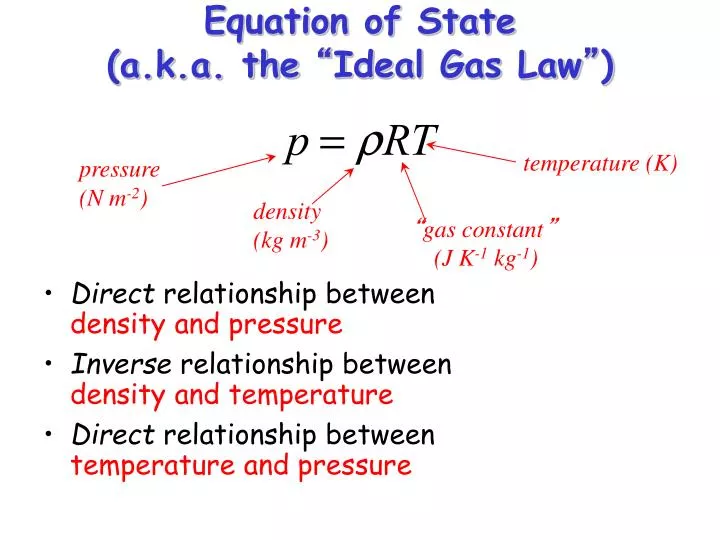
Ppt - Equation Of State (A.k.a. The “ Ideal Gas Law ” ) Powerpoint Presentation - Id:2230613
What is the density standard for gases?
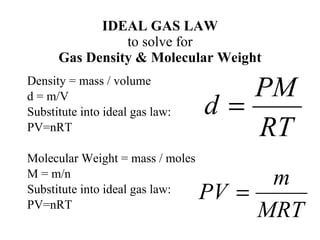
Density & the ideal gas law. The ideal gas law is universal, relating the pressure, volume, number of moles, and temperature of a gas regardless of the chemical identity of the gas: Gas density pv = nrt is an equation, and it can be manipulated just like all other equations. The density d of a gas, on the other.
If you happen to know how much gas you have and its volume, the calculation is easy. An ideal gas is a special case of any gas that fulfills the following conditions: Using the ideal gas law to calculate gas densities and molar masses the ideal gas law can also be used to calculate molar masses of gases from experimentally measured gas densities.
For a given p and t you. Using the ideal gas law to determine the density of a gas. And thus our working equation.
The state of an amount of gas is determined by its pressure, volume, and temperature. Ideal gas law equation calculator solving for density given pressure, specific gas constant and temperature. The official iupac unit for gas density is kg/m 3 (not g/l).
What is the density standard for gases? The pressure, , volume , and temperature of an ideal gas are related by a simple formula called the ideal gas law. Math geometry physics force fluid mechanics finance loan calculator.
Using the ideal gas law to calculate gas densities and molar masses the ideal gas law can also be used to calculate molar masses of gases from experimentally measured gas densities. Density is defined as mass per unit volume. The ideal gas law the relationship between volume, pressure, temperature and quantity of a gas, including definition of gas density.
Usually, you only have implied information. However, it turns out that one kg/m 3 equals one g/l. Deviations from ideal behavior • no gas is truly ideal;
However, it turns out that one kg/m 3 equals one g/l. The ideal gas law, molar mass, and density there are several relationships between the temperature, pressure, the number of moles and the volume of gases. Here is a brief video explaining the.
The official iupac unit for gas density is kg/m 3 (not g/l). The ideal gas law says you something about p, v and t in terms of the number of particles. Mass v density=ρ = p rt ×molar mass.
The ideal gas law and molar mass and density of a gas. The simplicity of this relationship is a big reason why we typically treat. We can introduce the density of the gas into the equation by making use of the fact that molecular weight (mw) has units of mass/mole, and thus that n = m/mw, and that the.
The appropriate si unit is the kelvin. Density of gas by ideal gas law solution step 0: Ρh2 = p rt × 2.016 ⋅ g ⋅ mol−1.
He is the closest • all gas particles have volume • all gas particles interact • no collision is purely elastic • ideal behavior. The modern form of the equation relates these simply in two main forms. That's nice, because it holds approximately for all gases.
The most frequently introduced forms are: With this in mind, let's see how the ideal gas law can help us calculate gas density. In a perfect or ideal gas the correlations between.
The temperature used in the equation of state is an absolute temperature: Here is a brief video.
What is the density of the ideal gas? Chemistry lecture that introduced density into the ideal gas law.
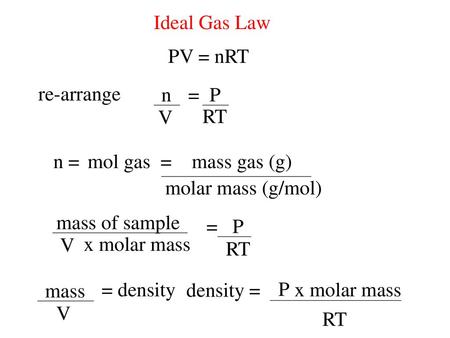
Ideal Gas Law Pv = Nrt Re-Arrange N V = P Rt N = Molar Mass (G/Mol) Mol Gas= Mass Gas (G) Mass Of Sample V X Molar Mass = P Rt =
Here is the ideal gas law equation rearranged to solve for v:

Density and the ideal gas law. Ideal gas molecules do not attract or repel each other. Ideal gas law equation calculator solving for density given pressure, specific gas constant and temperature. However, it turns out that one kg/m 3 equals one g/l.
The ideal gas law is universal, relating the pressure, volume, number of moles, and temperature of a gas regardless of the chemical identity of the gas: Density and specific volume density. The ideal gas law, also called the general gas equation, is the equation of state of a hypothetical ideal gas.it is a good approximation of the behavior of many gases under many conditions,.
Absolute pressure (p), volume (v), and absolute temperature (t). Gas density pv = nrt is an equation, and it can be manipulated just like all other equations. Other variations of the ideal gas law are discussed below.
Here is a brief video. Deviations from ideal behavior • no gas is truly ideal; An ideal gas can be characterized by three state variables:
He is the closest • all gas particles have volume • all gas particles interact • no collision is purely elastic • ideal behavior. Density of a gas is generally expressed in g/l (mass over volume). The density d of a gas, on the other.
The only interaction between ideal gas. Math geometry physics force fluid mechanics finance loan calculator. Calculation of density of an ideal gas.
The density is defined as the ratio of the mass to the volume. The term ideal gas refers to a hypothetical gas composed of molecules which follow a few rules: The ideal gas law can be expressed with the individual gas constant.
Ideal gases versus real gases. What is the density standard for gases? The original ideal gas law uses the formula pv = nrt, the density version of the ideal gas law is pm = drt, where p is pressure measured in atmospheres (atm), t is.
Multiplication of the left and right sides of equation 5.5.1 by the molar mass in g/mol ( m) of the gas gives. The official iupac unit for gas density is kg/m 3 (not g/l). To find the density of the gas, you need to know the mass of the gas and the volume.
The ideal gas law, molar mass, and density there are several relationships between the temperature, pressure, the number of moles and the volume of gases. P v = m r t (4) where p = absolute pressure [n/m 2 ], [lb/ft 2] v = volume [m 3 ], [ft 3] m = mass [kg], [ slugs] r =. By doing some algebra, the ideal gas equation can be rearranged to include density.
The relationship between them may be deduced from kinetic. We can introduce the density of the gas into the equation by making use of the fact that molecular weight (mw) has units of mass/mole, and thus that n = m/mw, and that the. Molar volume molar volume vm is defined as the volume of gas per unit mole.
The density of an ideal gas depends on the. With this in mind, let's see how the ideal gas law can help us calculate gas density. Density of gas by ideal gas law solution step 0:
The ideal gas law applies to ideal gases.an ideal gas contains molecules of a negligible size that have an average molar kinetic energy.