In chemistry lab, we did an experiment with water of various temperatures to extrapolate a value for absolute zero based on experimental pressure values for water at different temperatures. In some cases, the measurement may be so difficult that a 10 % error or even higher may be acceptable.
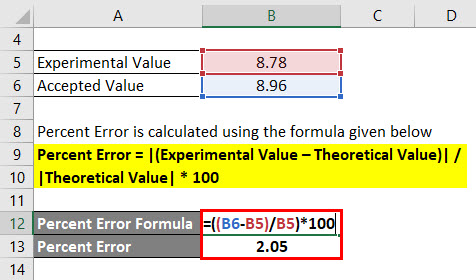
Percent Error Formula | Calculator (Excel Template)
As i consider both my relative.

Accepted percent error. If the experimental value is equal to the accepted value, the percent error is equal to 0. The forces applied to the body are in the order of 200 [nw]. Most high school and introductory university instructors will accept a 5 % error.
Percent error percent errors indicate how big our errors are when we measure something in an analysis process. If the negative sign is being dropped than the order you subtract in doesn’t matter. Note, this has two solution due to the absolute value in the percent error equation.
Error can arise due to many different reasons that are often related to human error, but can also be due to estimations and limitations of devices used in the measurement. Or, in short, subtract one value from another. In other cases, a 1 % error may be too high.
In my study the summation of forces must be zero, but in the simulations obtain values of 0.01 [nw]. Guide to percent error formula. To solve for the percent error using this formula, you can apply the following steps:
When measuring data, the result often varies from the true value. The infinity comes from the division by zero. For example, a 1% error indicates that we got very close to the accepted value, while 48% means that we were quite a long way off from the true value.
Here we will learn how to calculate percent error with examples, calculator and downloadable excel template. The first thing you need to do is to subtract the accepted value from the experimental value. Start off by subtracting one of the values from the other value in the equation.
Percentage error is a measurement of the discrepancy between an observed and a true, or accepted value. Subtract the theoretical value of your measurement from the value that you actually observed. Calculate the percentage error if the actual measurement of the value is 12 cm.
There are plenty of scientific endeavors where a percent error of 1,000% would be welcomed. But this is only a guideline. Smaller percent errors indicate that we are close to the accepted or original value.
The acceptability of a percent error depends on the application. Then, take the absolute value you got as a result of step 1. Solving for the actual, true or accepted value in the percent error equation.
The percent error of a measurement provides an indication of the extent to which the actual measurement taken during an experiment agrees with an accepted value of an equal amount. As the accuracy of a measurement decreases, the percent error of that measurement rises. It’s critical to remember that it matters whether or not the sign is kept in the calculation.
Calculate percentage error between experimental measured values and theoretical actual values. To calculate the percent error, follow the steps listed below:
Generally, this occurs when you take the measurement of a quantity that’s small on. If we are ignoring the sign, the order does not matter.
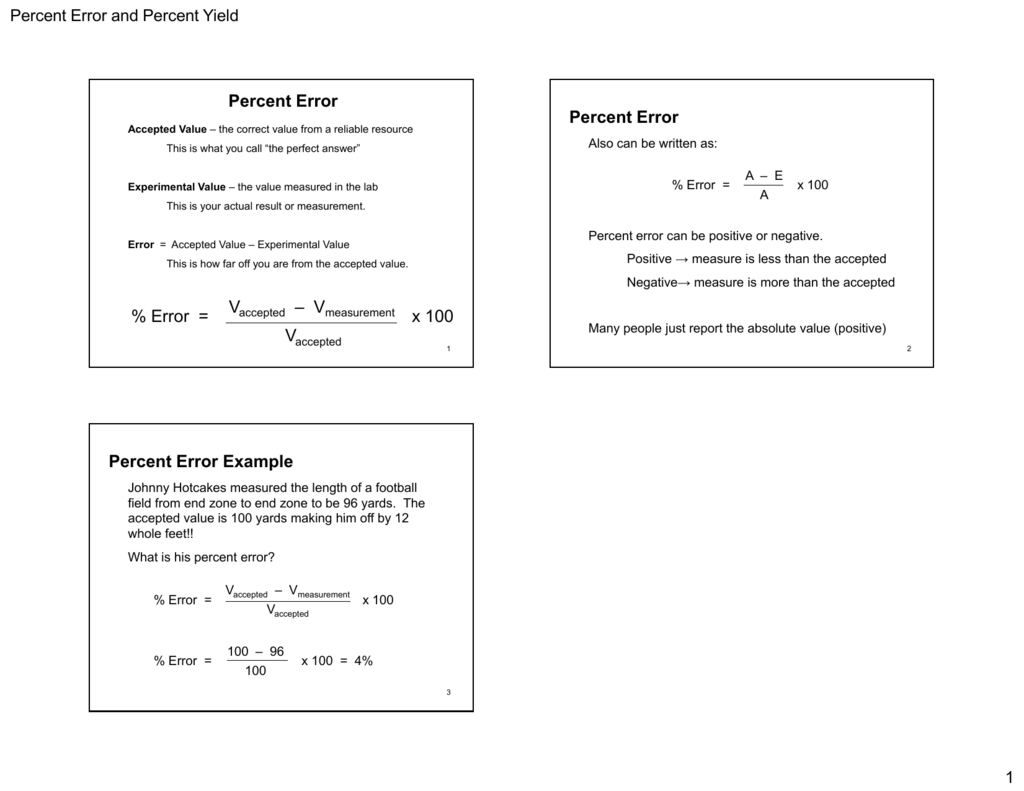
Percent Error And Percent Yield 1 Percent Error X 100 % Error
Whether it is erroneous is subject to debate.

Can percent error be over 100. You can put this solution on your website! Below steps describe how to obtain the percent error in detail. How are systematic errors removed usually for an instrument?
Just be careful where you use it. Is it possible to have a percentage error greater than 100? Most academics define mape as an average of percentage errors over a number of products.
This uncertainty should, however, be. Yes, a percentage error of over 100% is possible. In some cases, the measurement may be so difficult that a 10 % error or even higher may be.
The percent error can become over 100 if the fraction on the right is more than 1 and this is a possibility. By clicking “accept all cookies”, you agree to the storing of cookies on your device to enhance site navigation, analyze site usage, and assist in our marketing efforts. The acceptability of a percent error depends on the application.
However beware that mape has many. A percentage represents the ratio of part to whole, multiplied by 100. The percent uncertainty is then the ratio of the standard error to the mean value (times 100), % uncertainty = 100 × σ x ¯ n this number is larger than 100 if the fraction on the right side is.
However, this interpretation of mape is useless. The absolute error is then divided by the. It is normal to have values above 100% due to the uncertainty caused by errors and normal variations in performing the whole test procedure.
The ratio of part to whole is expressed in the form of a fraction. Yes, there is such thing as a percentage being over 100%. Actual is 1, you predict 3, so mape is 200%).
Step 1:take the difference of one value from another. Subtract one value from the other. The computation of percentage error involves the use of the absolute error, which is simply the difference between the observed and the true value.
So mape >100% means that the errors are much greater then the actual values (e.g. How are systematic errors removed usually for an instrument? Systematic errors arise due to careless or.
Divide by the old value. When the experimental value is twice the true value, a. Theoretically impossible, while experimental value might be higher than 100% for several reasons.
Stay tuned with byju’s for more such interesting articles. A company, for example, has had a really good day of sales and made a bigger profit then they. Typical experimental errors might be up to 10%, and you may have the.
Divide by the exact value.