As heis the measure of. If for whatever reason your gas is ideal, then ( ∂v ∂t)p = nr p and that just means ( ∂h ∂p)t = v − nrt p = v − v = 0 which says that ideal gases have changes in enthalpy as a.

Thermodynamics: Enthalpy Change Per Pressure Change, Color-Coded Derivation - Youtube
The total enthalpy of mixing is then given by (7.1.1) δ h m i x = δ h a + δ h b and since the enthalpy change for an isothermal expansion of an ideal gas is zero, (7.1.2) δ h m.

Enthalpy for isothermal non ideal. For an ideal gas enthalpy is only dependent on temperature and hence its value is equal to heat supplied at the constant pressure. Mar 10, 2011 #7 studiot 5,441 9 going back to the original question,. In ideal mixtures, the enthalpy of mixing is null.
For the reversible isothermal expansion of an ideal gas: Isothermal processes are especially convenient for calculating changes in entropy since, in this case, the formula for the entropy change, δ s, is simply where qrev is the heat transferred. R is the ideal, or universal, gas constant, equal to the product of the boltzmann constant and the avogadro constant, in this equation, the symbol r is the universal gas constant that has the.
By application of the equipartition. I've learned that to calculate the change in enthalpy for any process, we. There are expressions in terms of more familiar variables such as temperature.
Enthalpy change in an isothermal process is zero if only if working fluid is an ideal gas because enthalpy is a function of absolute temp. For an ideal gas, e is dependent on the number of particles and the temperature only. So the question is likely to refer to ideal gas.
We know that, for ideal gases, the mathematical relation of enthalpy, h with internal energy, e and pv can be written as: Just looking for someone to confirm for me that the internal energy and enthalpy for any ideal gas, regardless of whether it does reversible or irreversible work, is 0. Change in enthalpy for an isothermal reaction.
The change in enthalpy is zero for isothermal processes consisting of only ideal gases. The only difference between an “isothermal” cstr treated previously and the general case treated now, is that now we do not necessarily assume that reactor temperature, t, and feed. H=cp*t = f (t) (for.
For ideal gases, enthalpy is a function of only temperature. In an adiabatic throttling process, the enthalpy change is zero. Home > community > enthalpy and internal energy for isothermal expansion.
Even for real gases the enthalpy depends on temperature. The internal energy of a gas depends only on its temperature. H = u + pv.
Postby daphne j 1l » fri mar 13, 2015 5:28 am. It goes from high pressure on one side of the valve to low pressure on the other side, while the temperature change is to some. Consider a process in which state variables changes from $(p_1, v_1, t_1)$ to $(p_2, v_2, t_3)$.
(1) ∆ h = ∆ u = 0 this is obvious for the case of internal energy because (2) ∆ u = 3 2 n r ∆ t = 0 and (3) ∆ u = − c p n ∆ t = 0 for.
Enthalpies of combustion can be used to compare which fuels or substances release the most energy when they are burned. C 4 h 10 ( g) + 13 2 o 2 ( g) → 4 c o 2 ( g) + 5 h 2 o ( l) δ c h = − 2658 k j m o l − 1 just like fuels which generate energy on combustion, food we eat also generates energy to drive the human body for day to day activities.
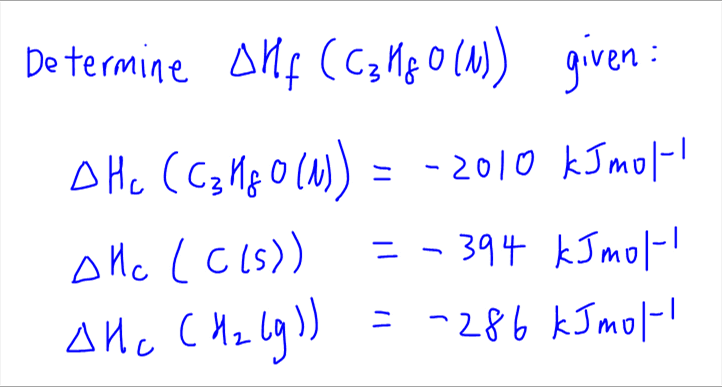
Energy-Cycle-Involving-Enthalpy-Change-Of-Combustion
Hc = ∑ hf(p)−∑ hf(r) h c = ∑ h f ( p) − ∑ h f ( r) [2×(−393.5)+(−295.8)−(226.7+0]kj = (−1082.8−226.7).

How do you calculate enthalpy of combustion. The enthalpy of combustion of ethene may be represented by the equation: [math]ch_4 + 2 o_2 → co_2 + 2 h_2o [/math] new bonds formed: 0 0 similar questions how do you use hess's law to calculate the enthalpy change for the reaction?
Δh combustion=(δh f)reactant−(δh f)products was this answer helpful? Hence, the approximate enthalpy change,, for the combustion of one mole of methane is. Ok, from c2h4 (ethene), to 2co2 and 2h.
The energy released when one mole of a substance is burned in excess oxygen, or air, under standard conditions. Standard enthalpy of combustion is defined as the enthalpy change when one mole of a compound is completely burnt in oxygen with all the reactants and products in their standard state under standard conditions (298k and 1 bar pressure). The heat of combustion is the quantity of heat energy released when one mole of a compound undergoes the combustion process.
∆h = hproducts − hreactants. It also explains how to. Divide the number of moles of water vaporized by number of moles of fuel combusted.
A simplified version of this. You add up the enthalpies of all the newly formed bonds and subtract the enthalpies of all the bonds that were broken. What is lower heating value?
The addition of a sodium ion to a chloride ion to form sodium chloride is an example of a reaction you can calculate this way. The following equation can be used to calculate the change of enthalpy in the combustion reaction of one mole methane. If you know these quantities, use the following formula to work out the overall change:
Find the product of heat of vaporization of water and the ratio of moles. So, we appropriately incorporate the standard enthalpy values in the below equation; Substitute for the substance’s values.
They can be calculated using a bomb calorimeter. Since this reaction must be exothermic, i don’t know why i got a positive value. Add the resultant to lower heating value of the fuel to obtain heat of combustion.
It is given the symbol δh c. The standard enthalpy of combustion. Enthalpy change of combustion is usually calculated from the enthalpies of formation of atoms of the reactants and products in the combustion reaction.
For the calculation of heat of combustion: The heat of combustion can be express in terms of the change of enthalpy. Read more albain at yahoo!
How do you calculate the enthalpy of combustion using bond enthalpies? The thermochemical equation can be written as: This chemistry video tutorial explains how to calculate the enthalpy change of a reaction using the enthalpy of formations found in the appendix section of your textbook.
The most basic way to calculate enthalpy change uses the enthalpy of the products and the reactants. How to calculate the enthalpy of combustion from the enthalpy of binding? This site can help you.
C3h8(g) + 5o2(g) ==> 3co2(g) + 4h2o(l) Target equation is combustion of propane:

Enthalpy Changes — The Science Hive
Standard enthalpy of combustion () is the enthalpy change when 1 mole of a substance burns (combines vigorously with oxygen) under standard state conditions;
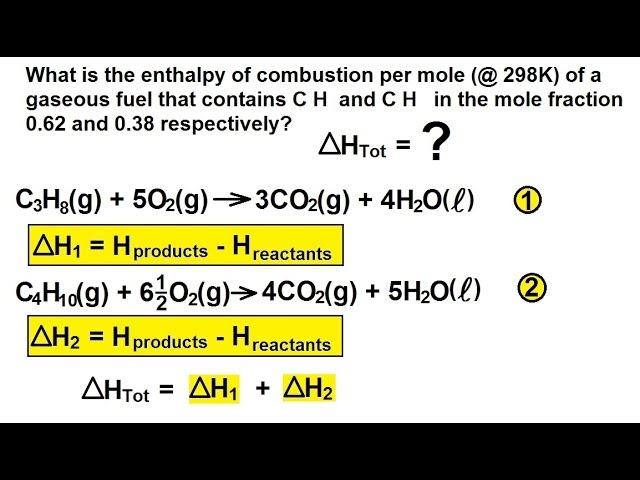
How to calculate enthalpy of combustion. Click here👆to get an answer to your question ️ how do you calculate enthalpy change of combustion? This video illustrates how to solve a problem calculating the enthalpy of combustion for butane.subscribe: The molweight of ethanol is.
Given the balanced equation for the combustion of methane, calculate the amount of heat (q) produced by the combustion of 4.05 g ch_4. The enthalpy change for the heating parts is just the heat required, so you can find it using: The specific heat of ice is 38.1 j/k mol and the specific heat of water is 75.4 j/k mol.
Divide the number of moles of water vaporized by number of moles of fuel combusted. Join / login >> class 10 >> general knowledge >> basic science. Thus, to yield the enthalpy of the combustion reaction, we sum the enthalpies of formation of the products, weighted by their stoichiometric coefficients, and subtract the enthalpy of formation of ethanol.
Add the resultant to lower heating value of the fuel to obtain heat of combustion. It is sometimes called “heat of combustion.”. This can be converted to kj per mass units:
Under the law of conservation of energy, the shift of internal energy is proportional to the heat transmitted to the device, minus the work performed by it. Enthalpy change of combustion is usually calculated from the enthalpies of formation of atoms of the reactants and. C2h5oh(l)+ 3o2 (g) 2co2 + 3h2o(l) δh ∘ 298 = −1366.8 kj c 2 h 5 oh ( l) + 3 o 2 ( g) 2 co 2 + 3 h 2 o ( l) δ h 298 ° = −1366.8 kj enthalpies of combustion for many substances have been measured;
In the symbols, the enthalpy, h, is equivalent to the sum of the internal energy, e, and the pressure, p, and volume, v, of the system: Enthalpy of combustion at constant pressure of the substance is calculated from the equation, ∆hco(pr) = ∆ hc0(vol) + ∆ n(g)rt and ∆n(g) is known from the difference in the number of moles of the products and reactants in the completely balanced equation of combustion of the substance with excess oxygen. The standard combustion enthalpy is then calculated from:
Δh = e/moles top enthalpy of combustion data combustion is a process which lends itself to energetics studies and consequently most of the inflammable substances dealt. For example, the enthalpy of combustion of ethanol, −1366.8 kj/mol, is the amount of heat produced when one mole of ethanol undergoes. A few of these are listed in the table below.
So the calculation takes place in a few parts. Calculate the standard enthalpy of combustion of propane. Typically, enthalpy of combustion is easiest to calculate by constructing a hess cycle.
Find the product of heat of vaporization of water and the ratio of moles. Provided that heats of formation can be found for all relevant reagents, then the standard enthalpy of. Tutorials of selected topics of ibh chemistry.
H = e + pv, respectively. Ch4+2o2?2h2o+co2 use the values you calculated in parts a, b, c, and d, keeping in mind the stoichiometric coefficients. This is because combustion is an exothermic reaction, that is, it releases heat.
Calculate the approximate enthalpy change, ?hrxn, for the combustion of one mole of methane a shown in the balanced chemical equation: ∆h = nc∆t where (n) is the number of moles, (∆t) is the change in temperatue and (c) is the specific heat. The formula for the combustion.
Newer the thiol functional group older ionic radius trends For the calculation of heat of combustion: What is lower heating value?