−191.5 °c or 81.6 k. What does a dotted wedge represent a bond going into the plane of the paper 4 bonded pairs, 0 lone pairs tetrahedral shape 3 bonded pairs, 1 lone pair pyramidal shape 2 bonded, 2 lone pairs non linear 2 bonded pairs, 0 lone pairs linear 3 bonded pairs, 0 lone trigonal planar shape 5 bonded, 0 lone pairs trigonal bipyramidal shape

Intermolecular Forces For Co2 (Carbon Dioxide) - Youtube
Being a linear molecule, co2 is non polar and hence the only force acting between co2 molecules is london dispersion force which the weakest intermolecular force of attraction.

Co2 intermolecular forces shapes. London dispersion forces are therefore, a significant contributor to the weak attraction between co molecules, which is consistent with the low boiling point: In the order of weakest to strongest: 180°, co2, normal diagram 3 bond pairs, no lone pairs, trigonal planar, 120°, bf3, normal diagram 4 bond pairs, 0 lone pairs, tetrahedral, 109.5°, ch4, 1 wedge.
Study about classification of molecular forces we hope this article on ‘intermolecular forces’ has helped you. Start studying shapes of molecules and intermolecular forces. I'm wondering which intermolecular forces will exist between carbon dioxide and water.
On the other hand, carbon dioxide, , only experiences van der waals forces. First you draw lewis structure of co2. The substance with the weakest forces will have the lowest boiling point.
It is more similar to sco molecules. Study as shape of molecules and intermolecular forces flashcards. Learn vocabulary, terms, and more with flashcards, games, and other study tools.
The four compounds are alkanes and nonpolar, so london dispersion forces are the only important intermolecular forces. There are five types of intermolecular forces. The more compact shape of isopentane offers a smaller surface area available for intermolecular contact and, therefore, weaker dispersion forces.
Let’s look at some common molecules and predict the intermolecular forces they experience. Determine the intermolecular forces in the compounds and then arrange the compounds according to the strength of those forces. Learn faster with spaced repetition.
The type of intermolecular force that holds together oxygen molecules is called a van der waal force. Create flashcards for free and quiz yourself with an interactive flipper. Co can be a hydrog continue reading more answers below guy clentsmith
Study shapes of molecules and intermolecular forces flashcards from phoebe liu's sacred heart high school class online, or in brainscape's iphone or android app.
At room temperature, ccl4 is a liquid while ch4 is a gas. The intermolecular forces that exist between molecules of ch4 are called dispersion forces.
Intermolecular Forces (Video) | Khan Academy
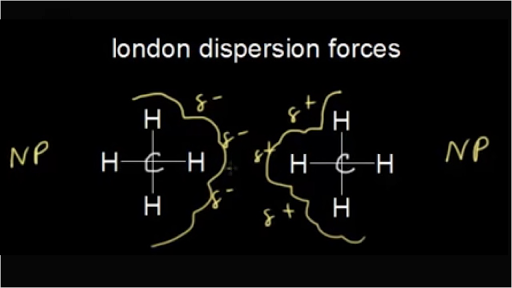
We draw this covalent bonding as a lewis structure (see diagram).

Intermolecular force ch4. What type of intermolecular forces are present in ch 4? The lines or sticks as we say represent the covalent bonds. The total number of electrons present in a ccl4 molecule is 32, while that in a ch4 molecule is 8.
In ch4(methane), the only intermolecular forcesare london dispersion forces. Methane ch4 is a covalent compound with exactly 5 atoms that are linked by covalent bonds. Methane ch4 is a covalent compound with exactly 5 atoms that are linked by covalent bonds.
Therefore the strongest intermolecular forces between ch4 molecules are van der waals forces. There are four bonds from a central carbon (c) linking or bonding it to four hydrogen atoms (h). In a single molecule of ch4 you would have intramolecular forces that are covalent bonds.
Which has stronger intermolecular force: What intermolecular force is ch4 if you are seeing this message, it means that we are having trouble uploading external resources to our website. See answer (1) best answer.
What is the strongest intermolecular force in ch4? The lines or sticks as we say represent the covalent bonds. The intermolecular forces that exist between molecules of ch4 are called.
If you are behind a web filter, make sure that the *.kastatic.org and *.kasandbox.org domains are unlocked. What are the inermolecular forces present in ch4? Intermolecular forces for ch4 (methane) 2,509 views jan 12, 2022 wayne breslyn 561k subscribers 38 dislike share in this video we’ll identify the intermolecular forces for ch4 (methane).
We draw this covalent bonding as a lewis structure (see diagram). Which is an intermolecular force quizlet? London dispersion forces are the result of temporary dipoles in molecules that are created when electrons are.
Methane ch4 is a covalent compound with exactly 5 atoms that are linked by covalent bonds. The cental atom in each of these molecules is c, n and o respectfully, of these n and o are There are four bonds from a central carbon (c) linking or bonding it to four hydrogen atoms (h).
The lines or sticks as we say represent the covalent bonds. In a single molecule of ch4 you would have intramolecular forces that are covalent bonds. We draw this covalent bonding as a lewis structure (see diagram).
The only intermolecular forces in methane are london dispersion forces. There are four bonds from a central carbon (c) linking or bonding it to four hydrogen atoms (h). Ccl4 has a much higher boiling point than that methane.