For this, let us assume that f (x) = sin x to be the function to be differentiated. The negative sine graph and the positive sine graph have opposite signs:
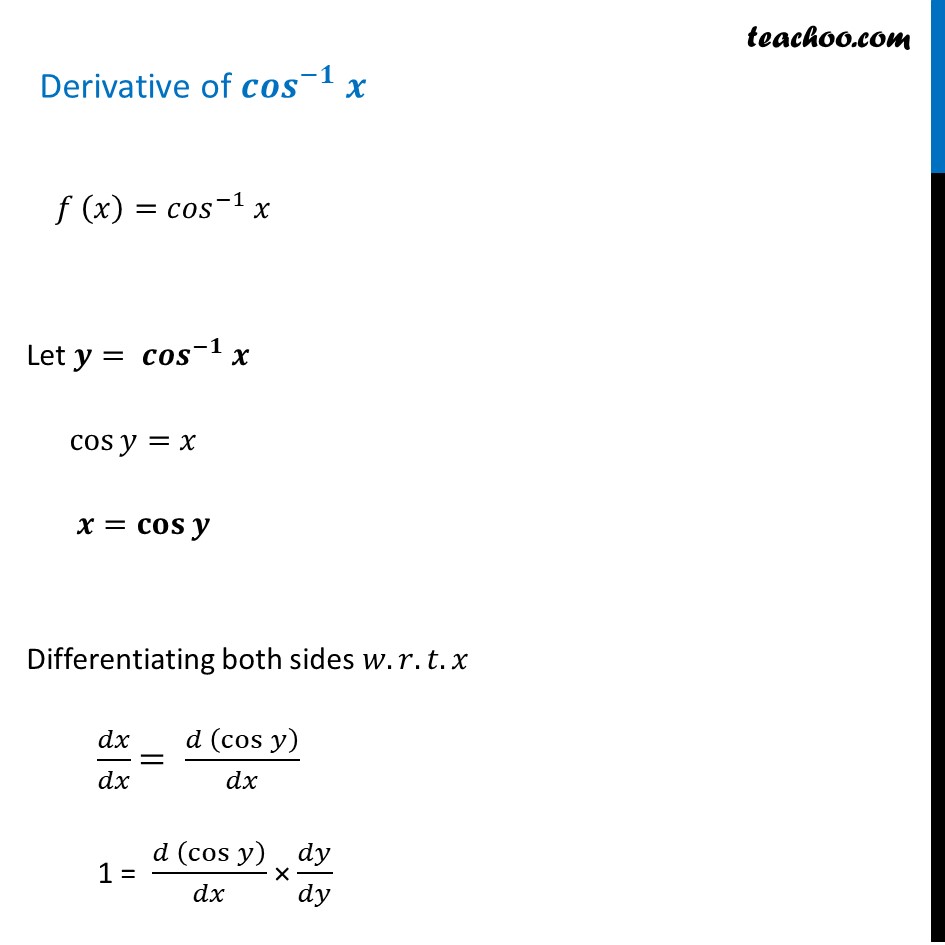
Differentiation Of Cos Inverse X (Cos^-1 X) - Teachoo [With Video]
D dx [sin( √ex + a 2)] not what you mean?

Derivative of negative sine. We can use the derivative of the sine function in order to compute directly the rate of change, or slope, of the tangent line at this peak on the graph: The derivative of the inverse tangent is then, d dx (tan−1x) = 1 1 +x2 d d x ( tan − 1 x) = 1 1 + x 2. Then f (x + h) = sin (x + h).
Sin’ (π / 2) = cos (π / 2) = 0 we. To remember which derivative contains the negative sign, recall the graphs of the sine and cosinefunctions. The derivative of the sine function d d x [ sin x] = cos x proof:
Now, if u = f(x) is a function of x, then by using the chain rule, we. In other words, it has no antiderivative, or no primitive, or no. It is also known as the delta.
Certainly, by the limit definition of the derivative, we know that d d x [ sin x] = lim h → 0 sin ( x + h) − sin ( x) h recalling the. The derivative of cosine of x is simply the negative sine of x. Then it must be the cases that sin θ = x implicitly differentiating the above with respect to x yields ( cos.
We have to start from the following statement about the limit of trigonometric function f (x) = sin(x) as its. Theorem 3.8 the derivatives of sin x and cos x the derivative of. The derivative of sin x is cos x, the derivative of cos x is −sin x (note the negative sign!) and the derivative of tan x is sec 2x.
Through a verysimilar we can find that the derivative of the cosine function is the negative sine function. From these we may derive the rest of the derivatives, via the quotient and product rules. There are three more inverse trig functions but the three shown here the most.
The function is not the derivative of anything. It says that the derivative of sine is cosine, and the derivative of cosine is negative sine. The first derivative of sine is:
The sine function is said to be. We have already seen that the derivative of the sine function is the cosine function. Derivative of sinx by the first principle.
If we were to follow the same steps to approximate the derivative of the cosine function, we would find that d dx(cosx) = −sinx. When people say “not integrable” they may mean one of several very different things. We are going to use the first principle to find the derivative of sin x as well.
For instance, we can identify the second. So, let's find the derivative of f (x) = sin(x) and then multiply it by −1. Finding the derivative of inverse sine function, d d x ( arcsin x) suppose arcsin x = θ.
Set differentiation variable and order in options. Derivative by the first principle refers to using algebra to find a general expression for the slope of a curve. Cos (x) the first derivative of cosine is:
Atx= 0, sin(x) is increasing, and cos(x) is positive, so it makes sense that the.
This website uses cookies to ensure you get the best experience. You can find the antiderivative (integral) of any function by following the steps below.
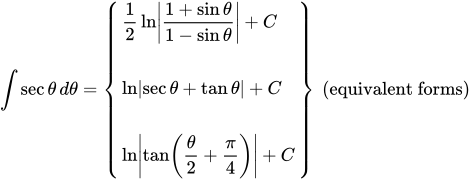
Integral Of The Secant Function - Wikipedia
= ∫ secx(secx +tanx) secx + tanx dx = ∫ sec2x + secxtanx secx + tanx dx

Anti derivative of sec. Type in any integral to get the solution, steps and graph. It is set as x by default. A few kilobytes of data.
Let us find the derivative of sec x + tan x with respect to x. The antiderivative calculator allows to integrate online any polynomial. X), after calculating the result 3 ⋅ x 2 2 + x 4 4 + x.
What is the antiderivative of sec x? The antiderivative of a function which is equal to 0 everywhere is a function equal to 0 everywhere. Jun 22, 2015 to find the antiderivative (or integral), there is a trick to this.
This rule is commonly known as the antiderivative power rule. Could somebody help me out, please? I figured that it might be a good idea if i showed how i got to sec(t)^(8/3) my initial problem was the following:
D⁄dxsec (x) = tan (x)sec (x) this derivative rule gives us the ability to quickly and directly differentiate sec (x). Maybe just because it's easier to memorize the derivatives and antiderivatives of the trig functions this way: What is the antiderivative of sec2(x)?
35x2 a tangent segment and a secant segment are drawn to a. Secx is an enormous, multidimensional space. Okay, maybe it is easier to deduce the proportion from the derivative rules, given the current conditions in math.
It's not a problem for us, who simply push that page forward. By using this website, you agree to our cookie policy. ∫secxdx you can multiply by secx +tanx secx +tanx.
D ( sec x + tan x) d x = sec x tan x + sec 2 x now, taking ( sec x + tan x) as common in the r.h.s of the above equation we get, The antiderivative of sec x is mathematically writen as ∫ sec x dx. What is the antiderivative of sec ( x) ?
For example, the derivative d ⁄ dy sec (y) = tan (y)sec (y), and the derivative d ⁄ dz sec (z) = tan (z)sec (z). For example, to compute an antiderivative of the polynomial following x 3 + 3 x + 1, you must enter antiderivative ( x 3 + 3 x + 1; The answer is the antiderivative of the function f (x) = sec2(x) f ( x) = sec 2 ( x).
By substituting f (x) = sec x and f (x + h) = sec (x + h) in this formula and simplifying it, we can find the derivative of sec x to be sec x. X may be substituted for any other variable. Nevertheless, the symmetry of the last two terms of the proportion suggests combining them.
$\sin$ always pairs with $\cos$, $\tan$ always pairs with $\sec$, and $\cot$ always pairs with $\csc$.these are the same pairs you already know from the sum/difference of squares formulas too, if your precalculus trig studies included all * 6. What is the antiderivative of 70x? But one or two dimensions.
The antiderivative rules are common for types of functions such as trigonometric, exponential, logarithmic, and algebraic functions. In the above problem, we are asked to find the antiderivative of sec x which means we have to find the integration of sec x. ∫ sec ( x) ( sec ( x) + tan ( x)) sec ( x) + tan ( x) d x =
That's why it's easy to split it up into slices. Select the definite or indefinite option. Click the load example button if you want to use a sample example.
Let s = sec θ, t = tan θ: What is the antiderivative of sec? F (x) = f ( x) = tan(x)+c tan ( x) + c
I got my function simplified to sec(t)^(8/3). Calculus introduction to integration integrals of trigonometric functions 1 answer jim h jan 25, 2016 tanx + c explanation: What is the antiderivative of secx?
The derivative rule for sec (x) is given as: Proof of the derivative rule Enter the function in the given input box.
I tried to use the reduction formula for sec(t)^n, but i believe that it only works if the power of sec is an integer.
Thus, derivative of sin (anything) = cos (anything) * derivative of anything. The derivative calculator has to detect these cases and insert the multiplication sign.
Solved 2) Find The Derivative Of The Trigonometry Function: | Chegg.com
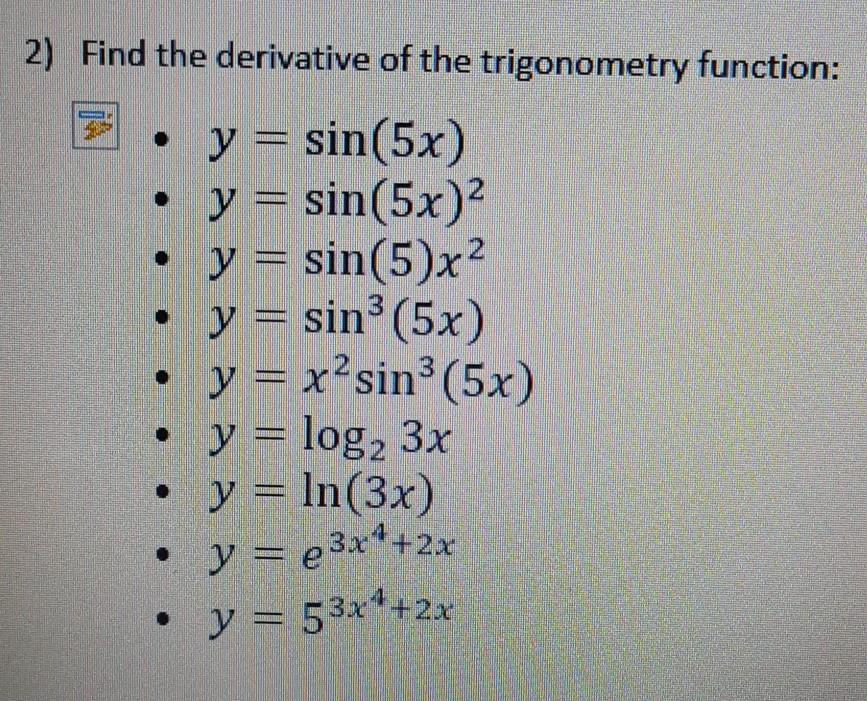
But the book says the answer is 5 cos 5x take the derivative of sin (x) = cos (x), then take derivative (using power rule) of the inside.

Derivative of sin5x. The 1st derivative is, as you know, f ′ ( x) = cos x and it is known from basic trigonometry that. A specialty in mathematical expressions is that the multiplication sign can be left out sometimes, for example we write 5x instead of 5*x. Join / login >> class 12 >> maths >> continuity and differentiability >> second order derivatives >> find the second order derivatives of.
In general, the derivative of sin ax is a cos ax. We know that the derivative of a composite function is found by using the chain rule. The derivative of with respect to is.
To apply the chain rule, set as. Cos x = sin ( x + π 2), whence, by an easy induction, f ( n) ( x) = sin ( x + n π 2). So, derivative of 5x = 5.
Now, if we are seeking the derivative of sin5x, we can rewrite our first equation: Jan 29, 2012 #3 cramie10 4 1 differenciating sin and cos is very easy. Take f ( x) = sin x, then f ( x + δ x) = sin ( x + δ x).
The derivative of sin x is cos x, the derivative of cos x is −sin x (note the negative sign!) and the derivative of tan x is sec 2x. According to definition of the derivative, the differentiation of the function in terms of x is written in the following limiting operation form. Since is constant with respect to , the derivative of with respect to is.
Replace all occurrences of with. Replace all occurrences of with. Do not try to solve it by applying logarithmic functions because it can make this simple problem complicated.
Find the derivative of the function at the point. It is proved in the same way that, if g ( x) = cos x , g ( n) ( x) = cos ( x + n π 2). The derivative of is 2k views view upvotes susairaj former retired teacher.
The derivatives of sin 2x and sin 2 x are not the same. Now, the proof of derivative of sin x with respect to x can be started by the first principle. Then g' (x) = u' (x) and f' (x) = cos x.
Derivative of the composite function sin (u (x)) sin (u (x)) is a composite function and hence it can be written as sin (u (x)) = f (g (x)) where g (x) = u (x) and f (x) = sin x. Whenever the function with respect to be derived is not given, then derivate it with respect to x for our convenience. The derivative of with respect to is.
Click here👆to get an answer to your question ️ find the second order derivatives of e^x sin 5x. D/dx (sin 2x) = 2 cos 2x d/dx (sin 2 x) = sin 2x topics related to derivative of sin 2x: Differentiate using the power rule which states that is where.
Now, if u = f(x) is a function of x, then by using the chain rule, we have: Differentiate using the chain rule, which states that is where and.
Quotient rule states if f (x) = g(x) h(x) then df dx = dg dx × h(x) − dh dx ×g(x) (h(x))2 Type the numerator and denominator of your problem into the boxes, then click the button.
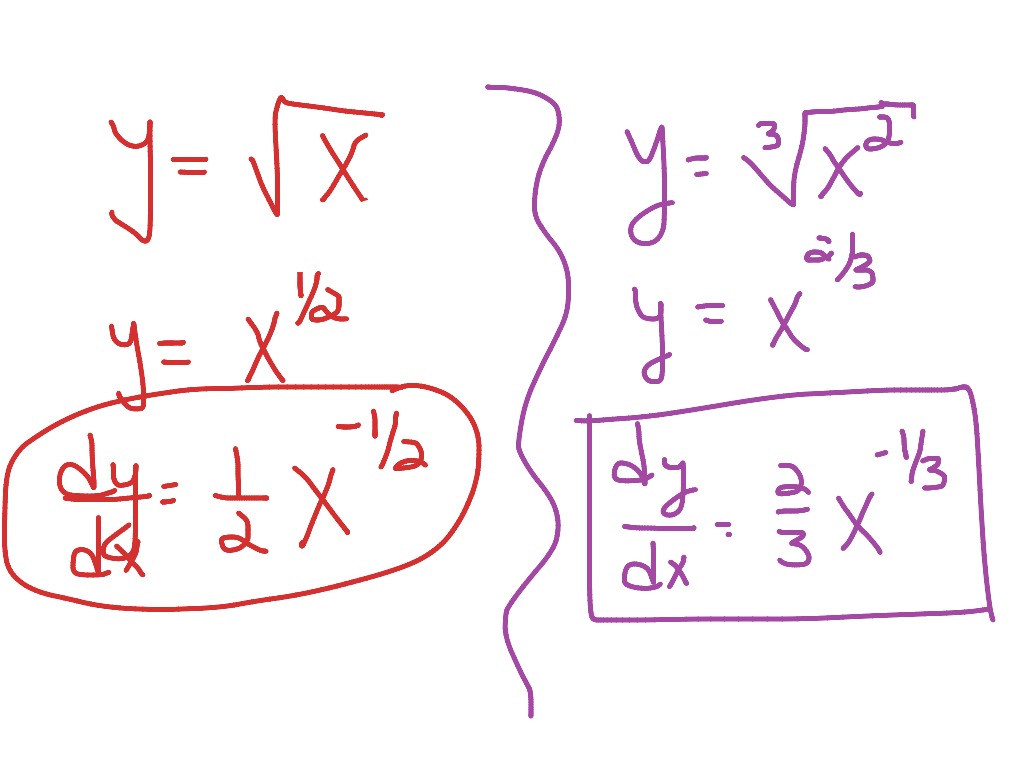
Derivatives: Power Rule With Fractional Exponents | Math | Showme
Caputo and others, which are not.
Taking derivative of the fraction. The notation for pure second derivatives is straightforward. Here we use quotient rule as described below. Instead of working with the notation of an infinite nested fraction, we will instead think about the value of a continued fraction in terms
The derivative tells us the slope of a function at any point. Use the power rule for only. Decimal to fraction fraction to decimal radians to degrees degrees to radians hexadecimal scientific notation distance weight time.
The quotient rule says that. In this video, i work out an example of taking derivatives involving fractions (not using the quotient rule). Result above, enter the function to derive.
Taking the derivative of a compound fractions; What you have is not a compound fraction. Finding the derivative of a function is called differentiation.
Taking the derivative of a compound fractions. Jul 14, 2021 · derivatives are used to find the slope of a curve line at an exact point. With the limit being the limit for h goes to 0.
D dx [sin( √ex + a 2)] not what you mean? Calculate the partial derivative with respect to of the following function. When we are given a fraction say f (x) = 3 −2x − x2 x2 − 1.
The derivative of a rational function may be found using the quotient rule: Anyway, let’s start at the beginning. Answers and replies aug 26, 2007 #2 d_leet 1,074 1 if you would show us some work, someone could point out the problem you are having.
This calculus video tutorial explains how to find the derivative of a fraction using the power rule and the quotient rule. Can you treat derivatives as fractions? Before we get into generalized continued fractions, we should start with their predecessors, just plain continued fractions.
Then from that product, you must subtract the product of f (x) times the derivative of g (x). 2 ignore and treat it like a constant. Higher derivatives 1 understand the notation for higher order derivatives.
Examples include fractions with x in the numerator and in the denominator. So in other words, say we want to take the derivative of the fraction: But it can also be solved as a fraction using the quotient rule, so for reference, here is a valid method for solving it as a fraction.
This page will show you how to take the derivative using the quotient rule. We start with the basic definition of a derivative that is Set differentiation variable and order in options.
The first thing you might try (well, that i tried) is to apply the quotient rule and chain rule on the expression in eq. I did the formula and had some issues, so i tried to check my answer with the power rule. There are rules we can follow to find many derivatives.
Just plug into the formula. We also have learned the power rule. The derivative of f (x) is mostly denoted by f' (x) or df/dx, and it is defined as follows:
Recommend this website if you like this website, then please support it by giving it a like. I'm not sure where i made the mistake, the formula or the power rule! Let f ( x) = 2 t 7 let the numerator and denominator be separate functions, so that g ( x) = 2 h ( x) = t 7 so f ( t) = g ( t) h ( t) the quotient rules states that
Then fx and dy are known as differentials and dy/dx really does become a ratio. The slope of a constant value (like 3) is always 0 the slope of a line like 2x is 2, or 3x is 3 etc and so on. Basically, you calculate the slope of the line that goes through f at the.
Definition of derivatives would be: H′(x) = (g(x))2g(x)⋅f ′(x)−f (x)⋅g′(x). Type in any function derivative to get the solution, steps and graph.
However they didn't come out the same. But i didn’t find an explanation of how to compute a derivative of a generalized continued fraction in any of these, which is why i wrote up these notes. This leads to an explosion of algebra but not an answer.
Here are useful rules to help you work out the derivatives of many functions (with examples below ). Can someone show me how to either rationalize this or take its derivative? No, you should keep in mind that dy/dx is defined as a limit, but, on the other hand, you can define dy as f’(x)dx where dx is arbitrary.
Second order partial derivatives can either be pure or mixed. The fractional derivative with the upper terminal at the right end of the interval [ a, b] is called the rigid fractional derivative.
Lim h → 0 sin x + h − sin x h lim h → 0 cos ( x + h + x 2) sin ( x + h − x 2) h now i got stuck. Therefore, the derivative of sin 2 ( x) is sin 2 x.
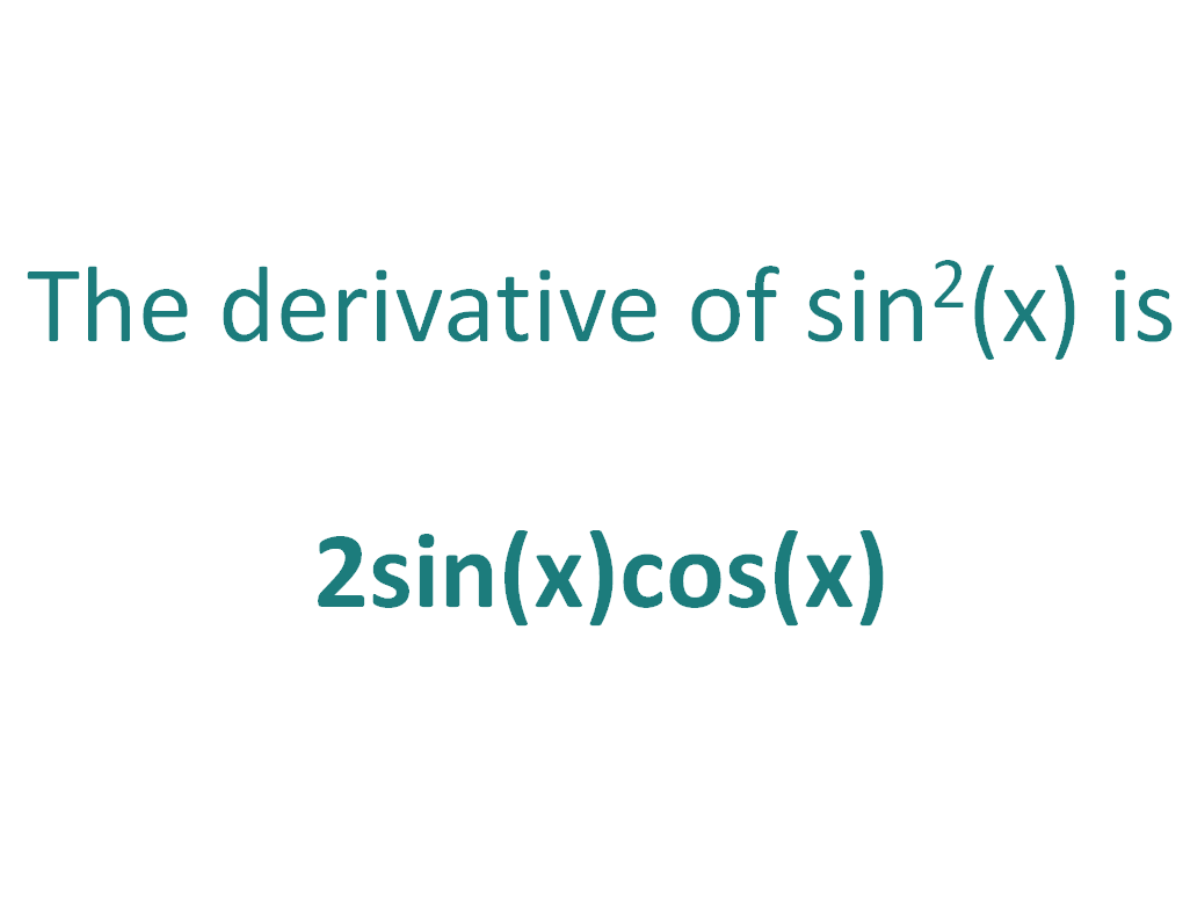
The Derivative Of Sin^2X? - Derivativeit
There are rules we can follow to find many derivatives.
Sin squared x derivative. Lim h → 0 f ( x + h) − f ( x) h using this definition, the derivative of sin x will be: Related » graph » number line » similar » examples » our online expert. Edited dec 9, 2012 at 10:35.
To calculate the derivative of the function sin (x)+x with respect to x, you. Derivative of e sin x: I have forgotten the trick to solving this one.
Next, we will find the derivative of x. We can find the derivative of sin inverse x using some differentiation formulas. The derivative tells us the slope of a function at any point.
What is the antiderivative of #sin^2(x)#? D dx [sin(x1 2)] d d x. D dx [sin( √ex + a 2)] not what you mean?
The derivative of sine squared x given the function f ( x) = sin 2 ( x) its graph shows and as we know by now, by deriving f ( x) = sin 2 ( x), we get f ′ ( x) = sin ( 2 x) which if graphed, shows. Find the derivative of sin 2 ( x). When the sine is squared, it becomes:
To do that, you'll have to determine what the outer function is and what the inner function. Sin2x = (p h p h)2. Sin x = perpendicular/hypotenuse = p/h sin2x = (p h p h)2 as a result, the sin square x formula looks like this.
Calculus introduction to integration integrals of trigonometric functions. Use the definition of a derivative to find the derivative. This calculus video tutorial explains how to find the derivative of the trigonometric functions sin^2(x), sin(2x), sin^2(2x), tan3x, and cos4x.my website:
We can find or prove this derivative using the chain rule and the derivatives of the fundamental trigonometric functions. Set differentiation variable and order in options. Answer 2sin(x)cos(x) explanation you would use the chain rule to solve this.
The derivative calculator allows steps by steps calculation of the derivative of a function with respect to a variable. Sin^3 (x) is sometimes written in the forms below (with the derivative as. F ′ ( x) = lim h → 0 f ( x − h) − f ( x) h.
These books made me much better at math o. Using the chain rule, the derivative of sin^3 (x) is 3sin2(x)cos (x) finally, just a note on syntax and notation: The slope of a constant value (like 3) is always 0;
The derivative of e sin x is cos x e sin x. Differentiate both sides w.r.t x using chain rule. Understand how to use the chain rule to find the derivatives of sin^2(x) and sin^3(x).check out cayla's video here: